


By R&D Team, Pacing Grass Private Limited
IIT Kanpur Technology Licensee · SIDBI Award Winner · DD Kisan Featured · Nexus Graduate
Published June 2026 · 14-minute read · pacinggrass.com
Introduction: India’s Plastic Problem Is Also an Opportunity
Every year, India generates over 3.5 million tonnes of plastic waste. According to India’s Ministry of Environment, Forest, and Climate Change (MoEFCC), a significant share is single-use cups, straws, and cutlery used for minutes and buried for centuries. On 1 July 2022, India banned 19 categories of single-use plastic items under the Plastic Waste Management Amendment Rules, 2021. The intent was correct. The execution ran into a wall: there were no Indian-made alternatives built for Indian food, Indian conditions, or Indian price points.
This isn’t a generic listicle about sustainability. This is a manufacturer’s guide—written by the scientists and engineers at Pacing Grass Private Limited who work with parali, rice husk, bamboo fiber, and coffee husk every single day. Our bio-composite technology is licensed from IIT Kanpur’s Startup Incubation and Innovation Centre. We won 1st position in the SIDBI program organized by KPMG in association with the Embassy of Israel. We were featured on DD Kisan national television. We graduated from the Nexus accelerator (US Embassy program). We don’t write about this material—we manufacture it. That distinction matters.
Our address: Khasra No. 427, Kadrabad, Modinagar, Ghaziabad (U.P.) | info@pacinggrass.com | +91 8810645505 | pacinggrass.com
| 3.5M+ Tonnes of plastic waste generated in India annually (MoEFCC) | 20M MT Rice stubble produced in Punjab per year—80% is burned (Down to Earth) | 500+ Years plastic persists in landfills. | 180 Days for our bio-composite to begin degrading in soil burial tests |
1. India’s Plastic Crisis: The Numbers Behind the Ban
The Down to Earth analysis of India’s plastic ban found that the 2022 ban targets only 19 specific items, accounting for roughly 11% of India’s total single-use plastic waste. The remaining 89% — including most food packaging — remains unaddressed. Meanwhile, the Outlook India coverage reports that even banned items remained in rampant circulation in Delhi and Mumbai because viable substitutes at scale did not exist at the time of the ban.
The peer-reviewed journal ScienceDirect (Plastic Bans in India, 2022) identifies the core challenge: alternatives to single-use plastic in the Indian F&B context must handle high oil temperatures, acidic gravies, and heavy portion weights—conditions that most imported ‘eco-friendly’ tableware products have not been designed for.
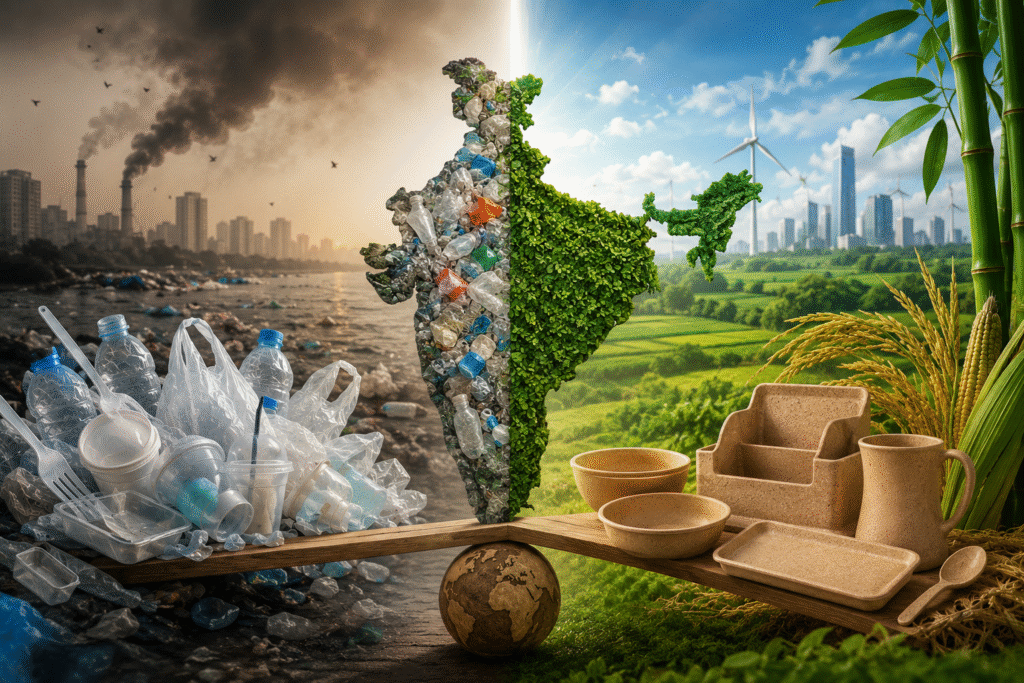
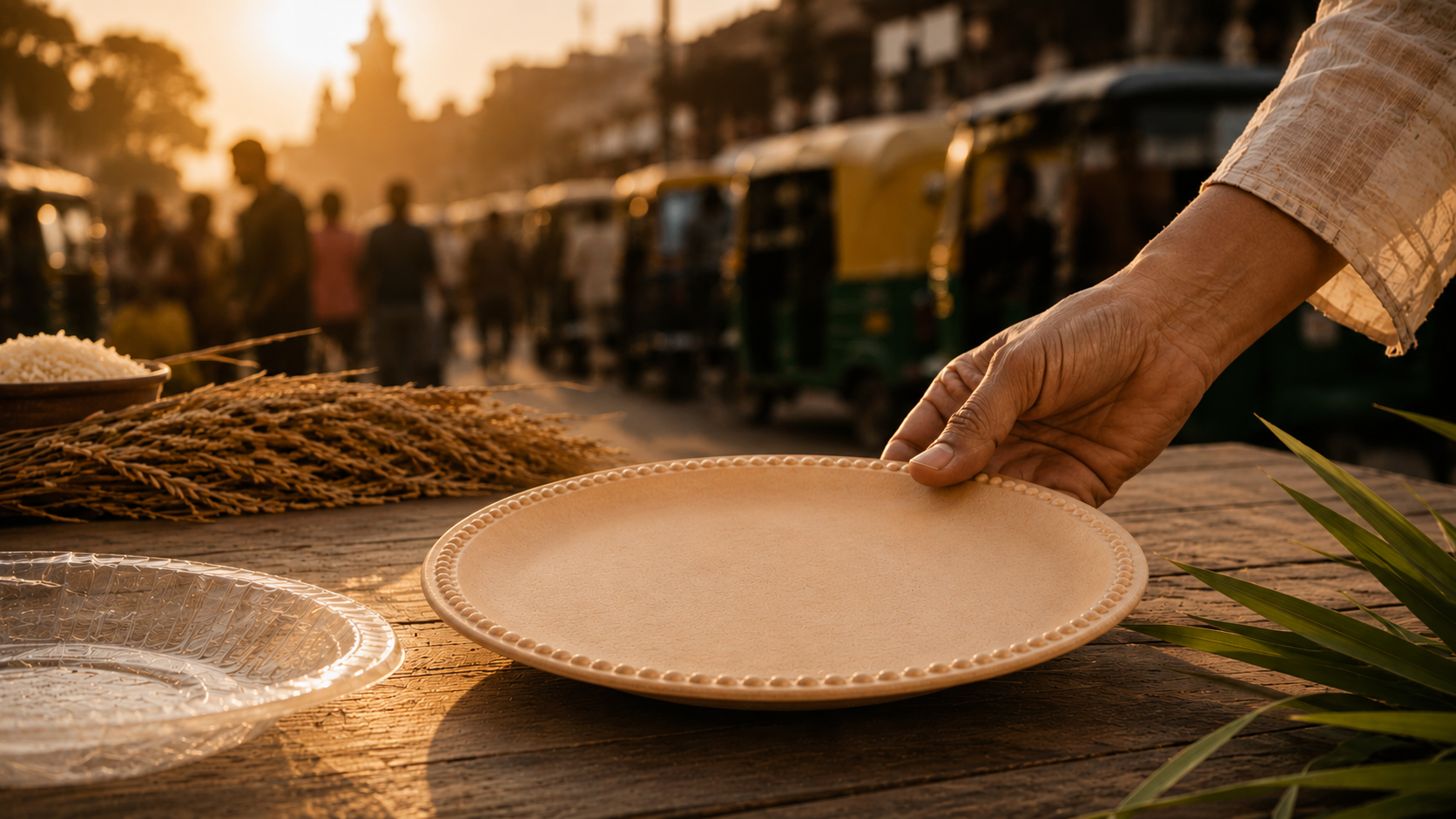
Most ‘eco-friendly’ tableware brands operating in India today are importers. They source bamboo products from Chinese factories, apply Indian branding, and sell at a premium. The material knowledge, the manufacturing IP, the supply chain—none of it is Indian. And critically, none of it is designed around Indian food: the oil temperatures of biryani, the alkalinity of dal, or the tamarind in rasam.
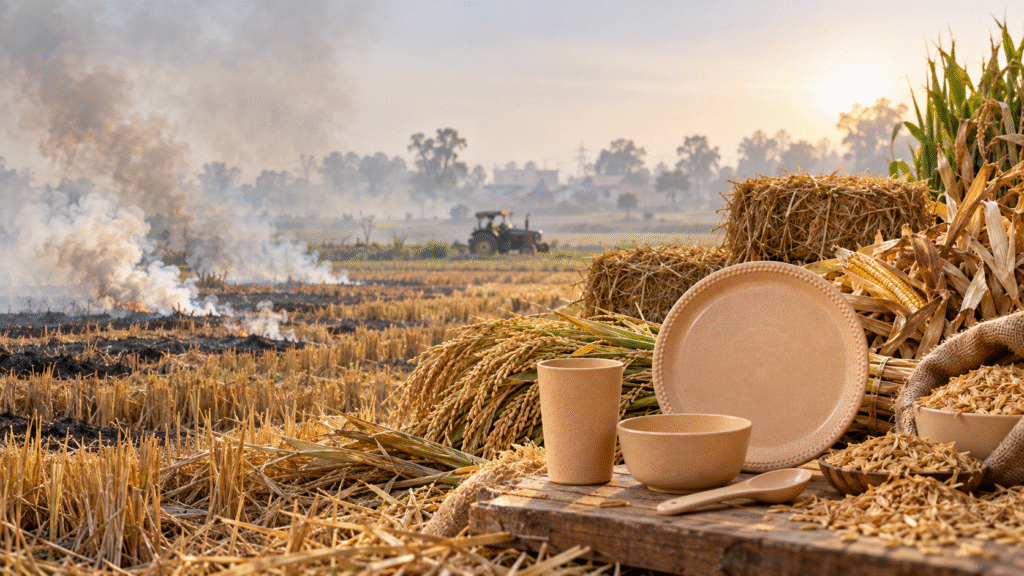
भारत में हर साल 20 मिलियन मीट्रिक टन से अधिक पराली पंजाब में उगाई जाती है—जिसका 80% जलाया जाता है। यह वायु प्रदूषण का कारण बनती है और एक अनमोल कच्चा माल बर्बाद होता है।
हमारी IIT कानपुर पेटेंट तकनीक इसी पराली और धान की भूसी को बायो-कम्पोज़िट टेबलवेयर में बदलती है—पूरी तरह भारत में, भारत के लिए।
2. The Parali Problem: From Field Fires to Finished Products
Every October and November, satellite imagery from NASA shows Punjab lit up like a forest fire. According to Down to Earth’s stubble burning analysis, over 20 million tonnes of rice stubble is produced in Punjab alone each year, and approximately 80% of it is burned. The Current Agriculture Research Journal (2024) documents that parali burning releases hazardous greenhouse gases, including CO₂, methane (CH₄), carbon monoxide, and nitrogen dioxide, at very high levels.
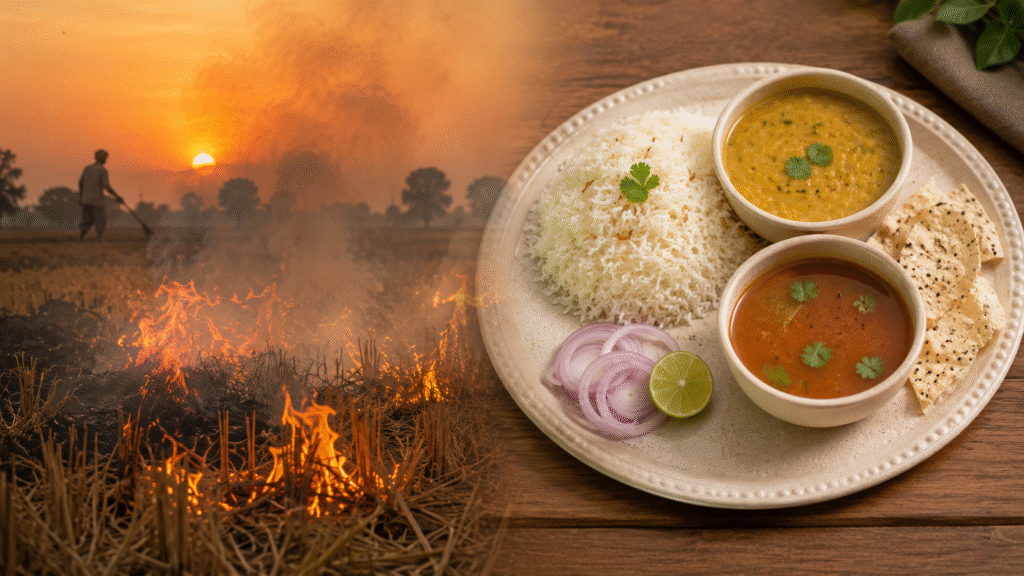
The chemical composition of rice straw is, in fact, remarkable: approximately 74.67% silica by ash weight — one of nature’s most thermally stable and mechanically robust compounds. At Pacing Grass, we identified this early: what farmers burn as waste is, from a materials science perspective, a high-value industrial feedstock. The same parali that causes Delhi’s October smog becomes, in our process, a structural reinforcement fiber in food-safe bio-composite tableware.
In addition to Parali, we work with:
- Rice husk — 20% silica by weight; provides thermal stability and structural rigidity
- Bamboo fiber—high tensile strength; provides flexibility and impact resistance
- Coffee husk — from coffee processing waste; adds density and surface finish quality
3. What is a bio-composite? The Science Behind the Material
The word ‘bio-composite’ gets used loosely in sustainability marketing. We will be precise: a bio-composite, in the context of Pacing Grass products, is a material formed by binding together natural, plant-derived fibers using a bio-based matrix (natural resins derived from plant-based sources) under controlled heat and pressure—without petroleum-derived plastics or formaldehyde-based binders.
3.1 Material Composition
Fiber matrix: Agricultural residues including rice husk (silica-rich), bamboo fiber (high tensile strength), parali/paddy straw (cellulose content 35–45%), and coffee husk—each chosen for specific mechanical properties.
Binder system: Natural bio-resin — no formaldehyde, no melamine, no BPA. Food-safe at temperatures up to 120°C.
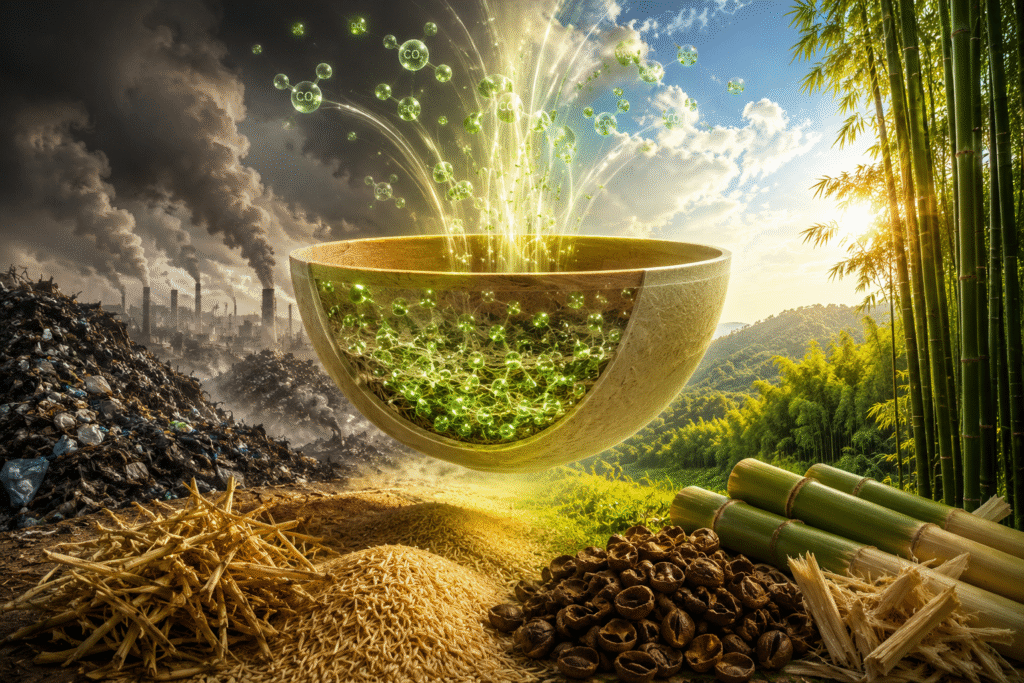
Carbon locking: Unlike burning parali (which releases CO₂ immediately), fixing the fibers into a durable product sequesters the carbon for the product’s lifetime. This is what makes our products carbon negative — the carbon captured during the plant’s growth remains locked in the material.
3.2 How Our Formulation Differs from Generic Bamboo Products
A 2023 life cycle assessment study published in ScienceDirect confirmed that bamboo fiber tableware demonstrates significantly better environmental coordination than polypropylene (PP) tableware across global warming, acidification, and other environmental impact metrics. However, the study notes that the ratio and quality of the fiber matrix are the critical differentiators between high-performing and mediocre bio-composite products.
The key difference between our bio-composite and ‘bamboo tableware’ sold by most Indian retailers is the engineered fiber ratio. Bamboo-only products can crack under thermal stress. Rice husk alone is too brittle. The science is in the blend — and the blend is what the IIT Kanpur patent protects.
Importantly, unlike many products described as ‘bamboo tableware,’ Pacing Grass products use a natural bio-resin binder—not melamine. The European Food Safety Authority (EFSA) has identified melamine-bound bamboo tableware as a safety concern when used with hot liquids. Our formulation eliminates this risk entirely.
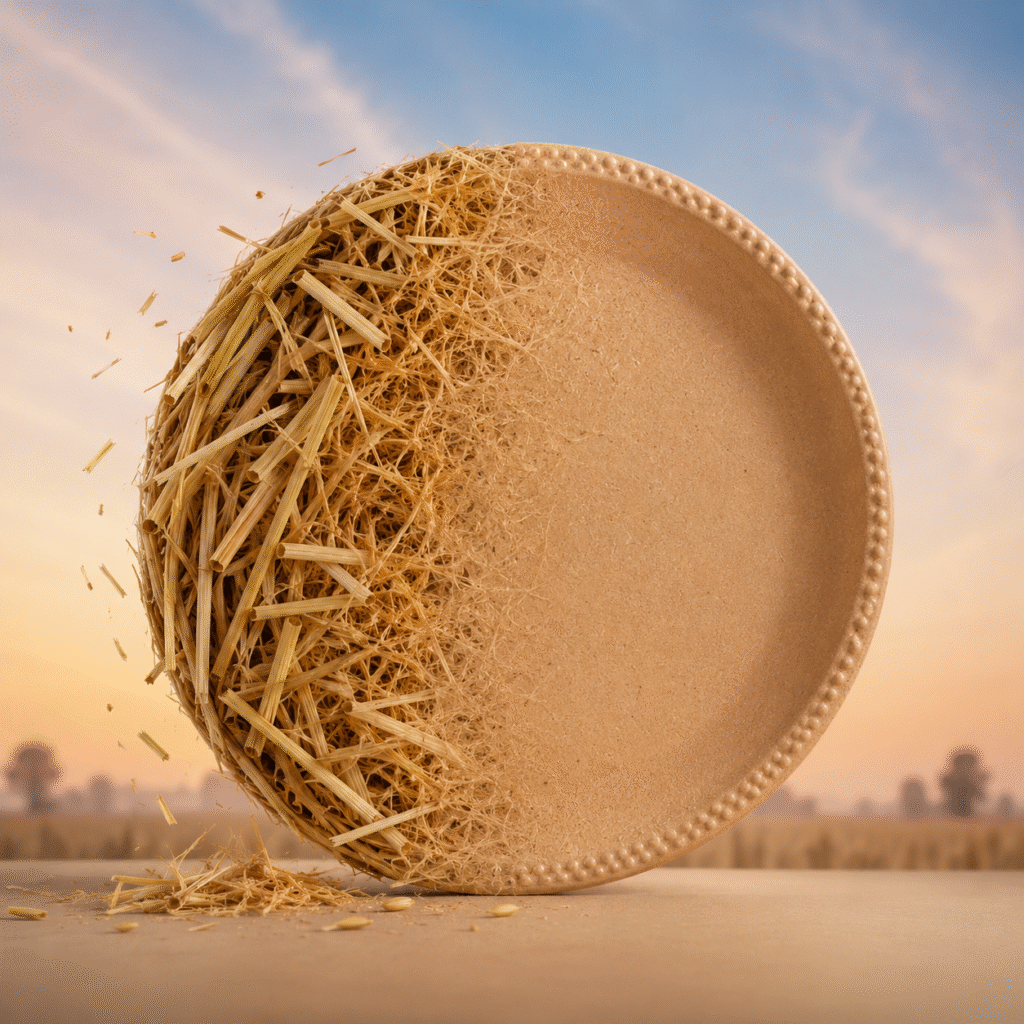
4. From Parali to Plate: Our Manufacturing Process
Most sustainability content describes the destination (eco-friendly product) without ever explaining the journey. Here is ours, in plain language.
- Agricultural sourcing: Raw parali, rice husk, and bamboo fiber are procured from farmers in Punjab, Haryana, and UP—materials that would otherwise be burned. Moisture content is tested at intake (target: below 12%).
- Pre-processing and cleaning: Fibers are cleaned, milled to specification, and screened for contaminants. Particle size determines the final surface finish.
- Blending and binder mixing: Fibers are blended with natural bio-resin at controlled ratios (a proprietary IIT Kanpur-licensed formulation). Homogenized for structural consistency.
- Hot-press molding: The blended mix is loaded into custom steel molds and compressed under heat (150–180°C) and pressure. This is where the material cures—fibers bond, the binder sets, and the shape is formed. Cycle time: 3–6 minutes.
- Quality and food-safety testing: Every batch undergoes food-safety migration testing: oil resistance (edible oil soak), water resistance (24-hour submersion), and load-bearing capacity (500g minimum for plates).
- End of life—composting: Products are compostable in industrial or home compost. In garden-soil burial trials, our plates showed 60–70% mass degradation within 180 days.
Products with fire-retardant properties meeting UL94V0 are available upon request—making our bio-composite suitable for engineering-grade and non-tableware industrial applications.
5. Bamboo vs Plastic: A Real-World Indian Comparison
Research from ECOsource on bamboo vs. plastic tableware safety confirms that the primary risks of conventional plastic tableware—BPA, phthalates, and microplastic shedding—are inherent to the material and unavoidable regardless of price point or brand. A 2023 study cited in Environmental Health Perspectives found that even BPA-free plastics may release other endocrine disruptors when heated or scratched.
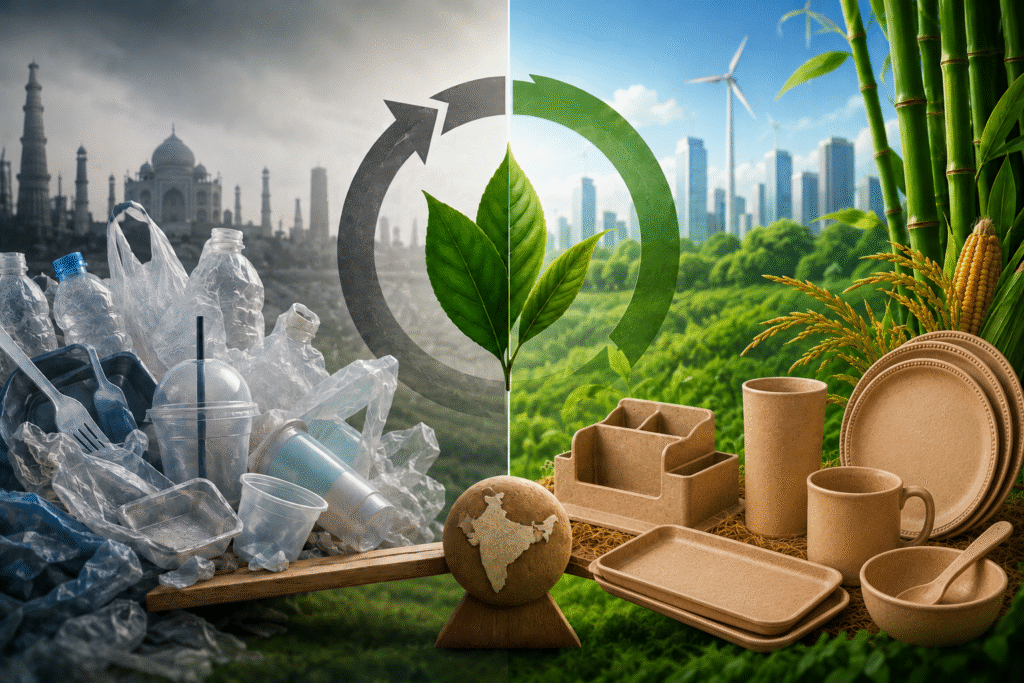
Here is how our bio-composite compares:
| Property | Single-use plastic | Pacing Grass bio-composite | Imported bamboo |
| Hot oil resistance (90°C+) | Leaches BPA / plasticisers | ✓ Passes oil migration test | Varies by brand |
| Water resistance | Excellent | ✓ 24 hr soak—no deformation | Can swell / crack |
| Tamarind acid resistance | OK (leaches at pH < 4) | ✓ No reaction at pH 3.5 | Discolouration possible |
| Biodegradation timeline | 500+ years | ✓ 180 days (soil burial) | 6–12 months |
| Carbon footprint | High (petroleum-derived) | ✓ Carbon sequestered | Depends on shipping |
| Made in India | Often | ✓ 100% | Typically China |
| OEM / custom available | Yes | ✓ Full OEM + branding | Limited |
All test data from the internal Pacing Grass QA lab. Soil burial degradation was tested over an 180-day in-house trial. Hot-oil resistance tested at 90°C with edible oil for 2 hours per batch.
6. For Restaurants and Hotels: The Plastic-Free Switch Guide
India’s F&B and hospitality sector is the largest single-use plastic consumer in the country. A mid-size restaurant in Delhi may use 200–500 plastic plates and cups per day. A 5-star banquet serving 500 covers uses more disposables in one evening than a small town uses in a week. The World Economic Forum notes that food, beverage, and consumer goods companies were among the loudest lobbyists against the 2022 plastic ban—precisely because no credible Indian-made alternative existed at scale.
What Hospitality Buyers Ask Us
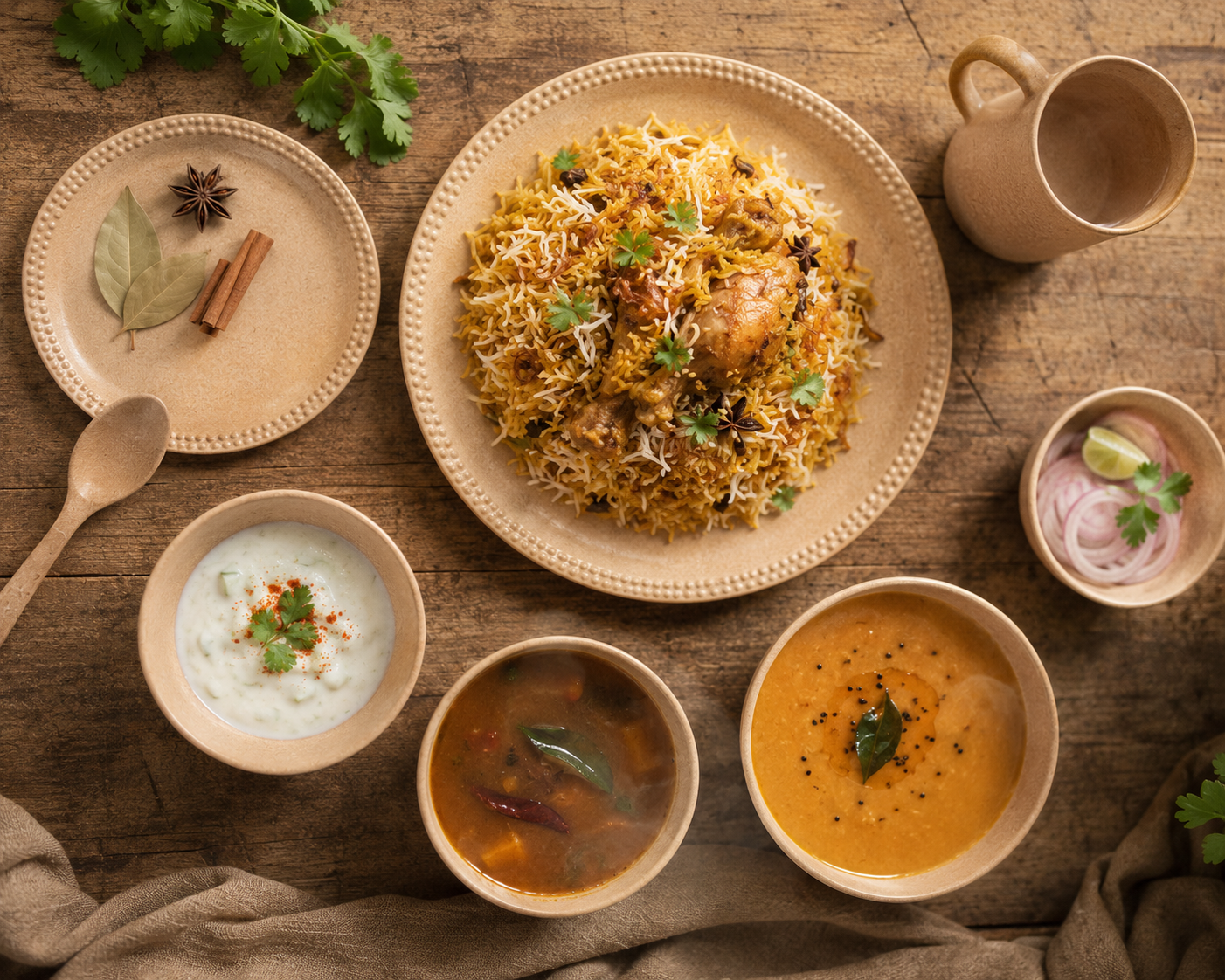
- ‘Will it leak?’ No. Our products pass the 24-hour water submersion test and the hot-oil resistance test. We provide samples for testing with your actual menu items before bulk ordering.
- ‘Can we brand it?’ Yes. Full OEM capability with custom molding (MOQ applies) or print/emboss on existing shapes. Turnaround for standard OEM runs: 4–6 weeks.
- ‘What about disposal?’ Products are compostable. For hotels and large banquet facilities, we can connect you with industrial composting partners in major metros.
- ‘What is the cost vs. plastic? ‘Bio-composite tableware sits at a modest premium over commodity single-use plastic at low volumes. At hospitality quantities (1,000+ units per SKU), per-unit costs become directly competitive—especially when landfill disposal costs for non-compostable waste are factored in.
Filter coffee sets for South Indian F&B: Our bio-composite filter coffee tumbler-and-dabarah set has been specifically engineered for the temperature and handling requirements of South Indian filter coffee service (75–85°C). This is a product category no imported sustainable brand has addressed. Enquire for hospitality volumes->
7. Eco Gifting for Diwali and Corporate CSR
India’s corporate gifting market is valued at approximately ₹14,000 crore in 2025 and projected to nearly double by 2030 (ChocoCraft / IBEF data). The overall India gifting market reached USD 75.16 billion in 2024 (TechSci Research). Despite this scale, the majority of ‘sustainable gifting’ options available to procurement teams in 2024 were either imported, generic, or not meaningfully eco-certified.
According to TechSci Research, eco-conscious consumers are increasingly drawn to brands offering products with a minimal environmental footprint. The IMARC Group’s India Gift Packaging Market report (2024) confirms that corporate entities are integrating eco-friendly packaging into gifting strategies to enhance brand image and ESG alignment—with bamboo home goods specifically cited as a rising category.
What Makes a Corporate Gift Actually Sustainable
- Manufactured in India from Indian agri-waste: The item has a verified origin story—parali from Punjab fields and rice husk from Haryana mills. This is a story the giftee can tell, making the gift memorable.
- Functional, not decorative: A bamboo fiber mug used daily sequesters carbon and displaces plastic every single day. A decorative item that sits on a shelf does neither.
- ESG-documentable: We provide material certificates, manufacturing declarations, and carbon footprint estimates per unit—the documents your ESG team needs for sustainability reporting.
- OEM and branded: Custom branding available—your logo on a bio-composite product that carries an authentic environmental narrative no imported alternative can replicate.
8. How to Care for Bio-Composite Products
Bio-composite tableware requires slightly different care from ceramics or steel. The difference between a product that lasts 3 years and one that lasts 3 months often comes down to washing and storage.
Do:
- Hand wash with mild soap and lukewarm water
- Dry immediately after washing
- Store in a dry, ventilated space away from prolonged moisture
Avoid:
- Prolonged soaking (24+ hours continuous immersion)
- Dishwasher heat cycles above 70°C — the binder begins to soften
- Sustained microwave exposure—brief reheating is fine; long microwave cycles are not
End of Life:
When the product shows cracking or significant wear, break it into smaller pieces and add it to a compost pile or bury in garden soil. Estimated degradation: 3–6 months in home compost conditions.
9. The Pacing Grass Product Range
Everything described in this article—the IIT Kanpur bio-composite, the parali-to-plate process, and the food-safety testing—is embodied in our current product range, available on our website and Amazon India.
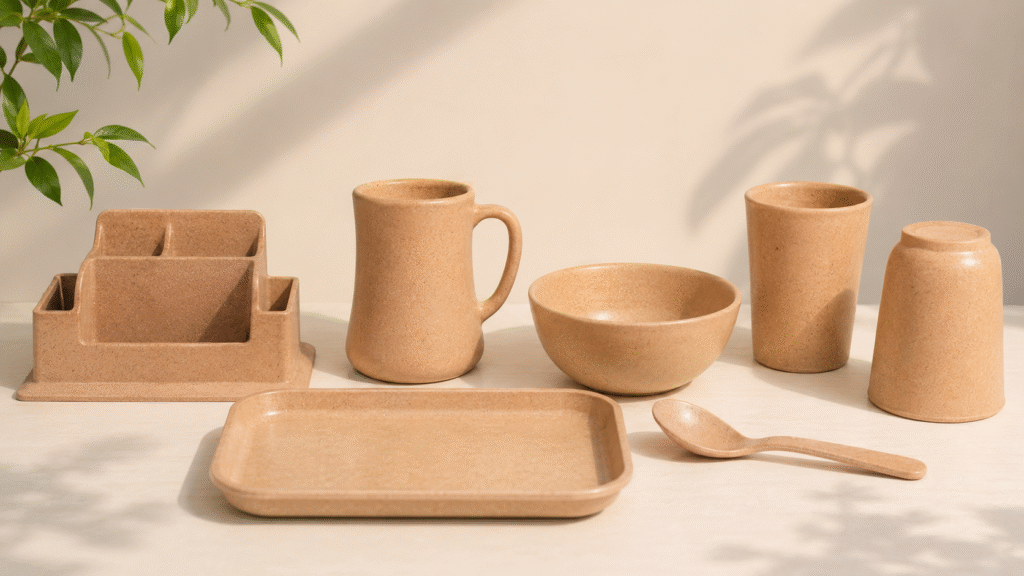
Here is the full range, with links to shop or inquire:
| Product | Category | Key Features | Where to Buy |
| Bamboo Plates — 8″ & 10.5″ | Dinnerware | Microwave safe, dishwasher safe, oil-resistant | pacinggrass.com/product-category/dinnerware/ |
| Bamboo Bowls — 300ml & 750ml | Dinnerware | Acid-resistant, tamarind-safe, carbon-locking | pacinggrass.com/product-category/dinnerware/ |
| Small Bowls — 200ml | Dinnerware | Perfect for chutneys, raita, condiments | pacinggrass.com/product-category/dinnerware/ |
| Coffee Mug — 300ml | Drinkware | Heat safe to 120°C, no BPA, no chemical leach | pacinggrass.com/product-category/drinkware/ |
| Glass — 300ml | Drinkware | Reusable, lightweight, carbon-negative | pacinggrass.com/product-category/drinkware/ |
| Eco Kullad — 160ml & 200ml | Drinkware | Replaces clay; reusable 50+ times | pacinggrass.com/product-category/drinkware/ |
| Filter Coffee Set | Drinkware | Designed for South Indian F&B — survives 75–85°C | pacinggrass.com/product-category/drinkware/ |
| Serving Tray—40×30 & 30×20cm | Serveware | Load-tested, non-slip, hospitality grade | pacinggrass.com/product-category/serveware/ |
| Table Organizer with Coaster | Gifting | Best-selling CSR / Diwali gift — custom branding available | pacinggrass.com/product-category/b2b-gifting/ |
| Spoon — 17.9cm | Cutlery | Bio-composite, food safe, disposable or reusable | pacinggrass.com/product-category/tableware/ |
| Bottle | Drinkware | Reusable bio-composite bottle — OEM available | pacinggrass.com/product-category/b2b-gifting/ |
Retail orders: pacinggrass.com/all-products/
Amazon India: search ‘PacingGrass.’‘
B2B and bulk enquiries: pacinggrass.com/product-category/b2b-gifting/
OEM and Custom Solutions: We accept custom orders for unique shapes, dimensions, and formulations, including fire-retardant grades (UL94V0 on request). Contact us at info@pacinggrass.com or +91 8810645505.
10. Awards and Recognition
Pacing Grass’s credentials are not marketing claims—they are independently verified recognitions from government institutions, international programs, and national media:
| 🏆 SIDBI 1st Position | KPMG × Embassy of Israel in India program for sustainable startups |
| 🌟 Emerging Startup of the Year 2023 | Headstart Network Foundation — Bharat Pitchathon 2.0 |
| 📺 DD Kisan Feature | National television — Revolutionizing Agriculture: Empowering Growth with Agritech Startups |
| 🎓 Nexus Graduation | US Embassy accelerator program — international product showcase |
| US Product Showcase | Presented to the Deputy Secretary of State, US Government |
Supported by: IIT Kanpur SIIC, Sabagris, IC IIT Patna, StartInUP (Government of UP), and the Nexus accelerator program.
References and Further Reading
All external references are to non-competitor, authoritative sources: government publications, peer-reviewed journals, and reputable news organizations.
Plastic Waste & Policy
- Down to Earth — How bad is India’s single-use plastic crisis? (2024) https://www.downtoearth.org.in/waste/how-bad-is-india-s-single-use-plastic-crisis–94667
- Outlook India — India’s Single-Use Plastic Ban Shows Mixed Results (2024) https://planet.outlookindia.com/news/indias-single-use-plastic-ban-shows-mixed-result-news-417123
- World Economic Forum — India’s ban on single-use plastics (2022) https://www.weforum.org/stories/2022/07/india-ban-policy-single-use-plastic-pollution/
- ScienceDirect — Plastic bans in India: socio-economic and environmental complexities (2022) https://www.sciencedirect.com/science/article/pii/S1462901122003458
- IndiaSpend — Three Months On, India’s Single-Use Plastic Ban A Dud (2022) https://www.indiaspend.com/pollution/three-months-on-indias-single-use-plastic-ban-a-dud-837111
Parali / Stubble Burning
- Down to Earth—Stubble burning: A problem for the environment, agriculture and humans https://www.downtoearth.org.in/agriculture/stubble-burning-a-problem-for-the-environment-agriculture-and-humans-64912
- Current Agriculture Research Journal — Stubble Burning in India: Environmental Concern and Alternative Tools (2024) https://www.agriculturejournal.org/volume12number1/stubble-burning-in-india-environmental-concern-and-alternative-tools/
- Mongabay India — Behind Punjab’s smoke screen (2023) https://india.mongabay.com/2023/08/behind-punjabs-smoke-screen-madhya-pradeshs-stubble-burning-problem-goes-unnoticed/
- PIB India—Stubble burning incidents decline (2023) https://www.pib.gov.in/PressReleaseIframePage.aspx? PRID=1973021
Material Science: Bio-Composite and Bamboo
- ScienceDirect—Life Cycle Assessment of Bamboo Fiber vs. PP tableware (2023) https://www.sciencedirect.com/science/article/abs/pii/S0926669023000432
- ECOsource—Bamboo vs. Plastic Tableware: Which is Truly Safer for Food? https://ecosourcecn.com/bamboo-vs-plastic-tableware-which-is-truly-safer-for-food/
- Nestacular — Plastic vs Bamboo vs Silicone Baby Tableware: Safety & Durability Guide (2025) https://nestacular.com/blogs/journal/silicone-vs-bamboo-vs-plastic-baby-tableware-safety-durability-guide
- AnzhuCraft — Are Bamboo Plates Safe for Food? (2025—citing EFSA 2021) https://www.anzhucraft.com/are-bamboo-plates-safe/
Corporate Gifting Market
- TechSci Research — India Gifting Market USD 75.16 Billion (2024) https://www.techsciresearch.com/news/9337-india-gifting-market.html
- ChocoCraft—Corporate Gifting Industry in India 2025–2030 https://www.chococraft.in/blogs/corporate-gifts/corporate-gifting-industry-india-2025-2030
- IMARC Group — India Gift Packaging Market size USD 2.2 Billion (2024) https://www.imarcgroup.com/india-gift-packaging-market
Ready to Make the Switch?
Retail orders: pacinggrass.com/all-products/
B2B & gifting: pacinggrass.com/product-category/b2b-gifting/
Email: info@pacinggrass.com | Phone: +91 8810645505
Amazon India: search ‘Pacing Grass.’
Purpose in Every Particle.