



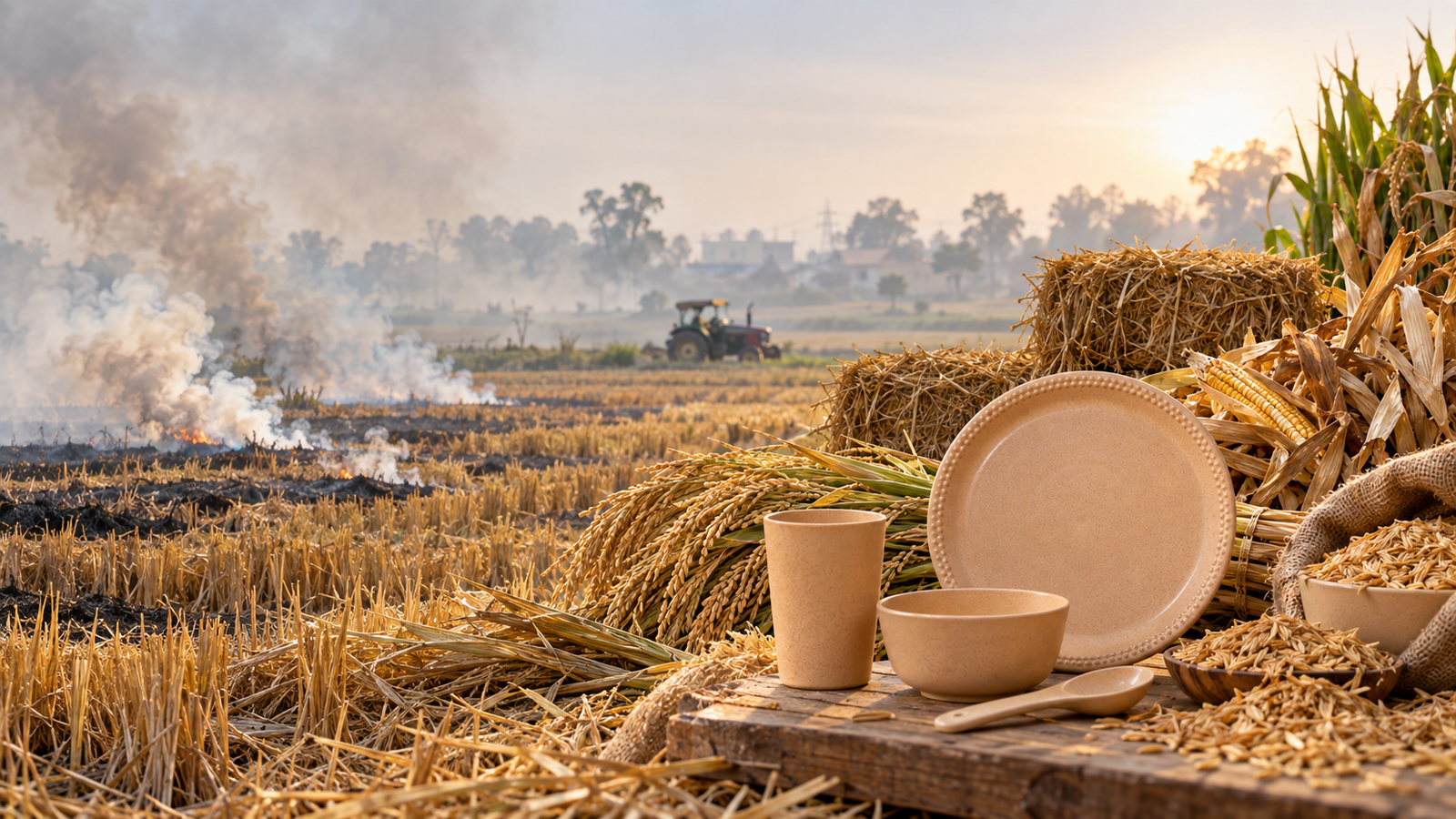
Every autumn, the same scene returns. The paddy harvest ends, fields across Punjab, Haryana and western Uttar Pradesh fill with smoke, and within weeks the sky over Delhi-NCR turns a heavy, pale grey. Words like AQI, PM2.5 and smog take over the news.
It is easy to look at a satellite image of burning fields and ask one simple question: why are farmers still burning crop residue? The honest answer is far more complicated than “farmers are polluting.” Stubble burning in India is a story about farm economics, a brutally short calendar and a regional air-quality problem that has more than one cause.
In this guide we look at the causes of stubble burning, what recent data says about Delhi air pollution, the alternatives that already work in the field, and where agricultural residue could go next. If you only have a minute, start with the key takeaways below.
What Is Stubble Burning in India?
After paddy is harvested, a heavy layer of straw and stubble stays in the field. The combine harvester removes the rice grain and leaves the stalks behind, and this leftover material is known as paddy straw, crop residue or parali.
[Image to be generated — paddy-straw-after-combine-harvest-punjab.webp — see the Image Prompts section above. Alt text: “Combine harvester leaving rows of paddy straw across a field in Punjab after the rice harvest”]
The scale is huge. India’s Ministry of New and Renewable Energy has estimated that roughly 500 million tonnes of crop residue are generated every year, and Punjab’s own residue targets cover more than 20 million tonnes of paddy straw.
The farmer’s problem is timing. Wheat has to be sown soon, thick straw interferes with sowing, and collecting and hauling it away takes labour, machinery, time and money. Burning clears a field within hours, which is why stubble burning in India is tied to the rice-wheat cropping system as much as to environmental awareness.
Why Do Farmers Burn Parali? The Causes of Stubble Burning
The short answer: for many farmers, fire is currently the quickest and cheapest way to clear a field before the wheat window closes. Four pressures explain most of the causes of stubble burning.
1. The 15 to 20 day squeeze
The biggest driver is the very short gap between paddy harvesting and wheat sowing. Punjab’s agriculture department told the National Green Tribunal that the window is only 15 to 20 days, and that machines may not be available when almost every farm needs them at once.
Delay the wheat and yields, and the economics of the whole farm, can suffer. Under that pressure, waiting for a shared machine can feel like a bigger risk than lighting a match.
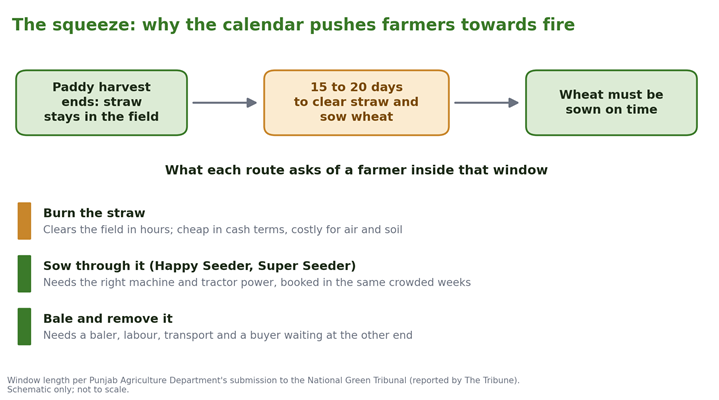
The calendar, not indifference, is what pushes many farmers towards fire. (Alt: Diagram of the 15 to 20 day window between paddy harvest and wheat sowing and what burning, seeding and baling each require)
2. Straw is bulky, and removing it costs money
Paddy straw is light but voluminous. Taking it out of a field means arranging machinery, labour, transport and somewhere to take it, and for a small farmer every extra operation is another expense.
3. Machines exist, but access is uneven
Punjab has distributed about 1.48 lakh crop residue management machines since 2018-19, and subsidies cover half the cost for individual farmers and up to 80% for custom hiring centres.
Even so, a survey of 400 wheat farmers in Punjab and Haryana found that short operating windows, difficulty arranging high-horsepower tractors, peer influence and worry about yield risk still slow adoption.
4. The “burning is easier than the alternative” trap
The alternatives exist, but they are not automatically cheap, convenient or available to every farmer at exactly the right time. So when we ask why do farmers burn stubble, the more useful answer is that the system currently makes disposal by fire quicker, and often cheaper, than managing the residue any other way. That is also why crop residue management in India has to be judged from the farmer’s side of the fence. A method that works on paper but arrives two weeks late does not help a field that must be sown tomorrow.
How Does Stubble Burning Affect Delhi Air Pollution?
This is where a farming problem becomes a regional air problem. In October and November, northwesterly winds can carry smoke from burning fields towards Delhi-NCR, just as cooler, stiller winter air makes it harder for pollutants to disperse.
On the worst days the effect is dramatic. SAFAR estimates put the farm-fire share of Delhi’s PM2.5 at 42% on 5 November 2020, and a similar peak in 2019, while on other days the share fell into single digits.
Averaged over a season, the picture is very different. A study published in January 2025 estimated that crop residue burning in Punjab and Haryana contributes only about 14% of PM2.5 in Delhi-NCR, and found no simple linear link between fire counts and Delhi’s PM2.5.
So saying “Delhi’s pollution is caused by stubble burning” is an oversimplification. A more accurate statement is that crop-residue burning is one seasonal contributor to a much larger, more complicated winter problem, alongside vehicles, industry, construction and road dust, biomass and waste burning, and secondary particles formed in the air.
The trend in the fires themselves is striking. Punjab’s official count fell from 71,304 in 2021 to 5,114 in 2025, about 93% lower and the lowest in over a decade, while Haryana logged 662 fires.
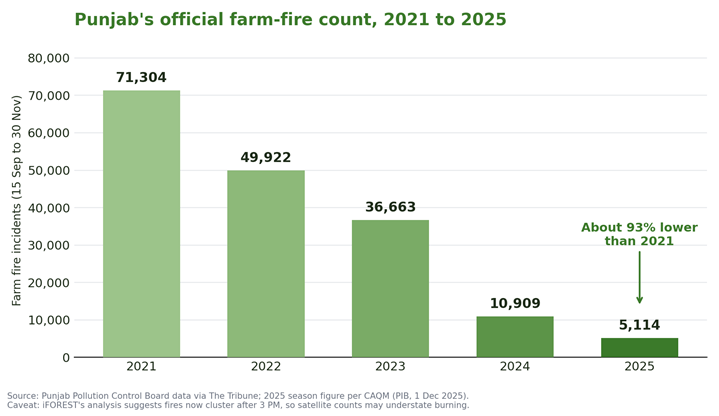
Punjab’s official farm-fire count fell sharply between 2021 and 2025, though independent analysis says afternoon fires may be under-detected. (Alt: Bar chart of Punjab’s official farm fire counts falling from 71,304 in 2021 to 5,114 in 2025)
Yet Delhi still recorded three severe-AQI days between 1 October and 30 November 2025, and December PM2.5 came in about 24% higher than a year earlier, after the fires had faded. Falling fire counts help, but they do not clear Delhi air pollution on their own.
There is also a measurement caveat. An iFOREST analysis argues that farmers in Punjab and Haryana increasingly light fires after 3 PM, a time standard satellite monitoring can miss, so the official decline may overstate the real fall. The fair reading is genuine progress, an incomplete picture, and no reason to stop looking for better options.
The Human Cost Is Bigger Than the Smoke
The debate around stubble burning and Delhi air pollution often becomes a fight between “farmers” and “city residents.” That framing misses something important: farmers and farm workers breathe this smoke too, and so do the villages around the fields.
Burning one tonne of paddy straw is commonly estimated to release about 3 kg of particulate matter and 60 kg of carbon monoxide, along with large volumes of carbon dioxide. The soil pays too, because rice straw holds a share of the crop’s nitrogen, phosphorus, potassium and sulphur that fire simply destroys.
Penalties have been part of the response. In the 2025 season Punjab imposed fines, registered FIRs and marked red entries in land records, yet farm unions continue to argue that farmers need practical support and incentives rather than punishment alone.
That leaves a real contradiction. The person being asked to stop burning is often the same person who needs a workable way to deal with the residue. This is why crop residue management in India cannot be solved through warnings, penalties or public messaging alone; it needs an alternative that works in the field and an economic system that makes the alternative worthwhile.
Alternatives to Stubble Burning: What Can Replace the Fire?
The good news is that no single magic technology is required. The alternatives to stubble burning fall into two broad groups: manage the residue where it is (in-situ), or take it somewhere else and use it (ex-situ).
Five alternatives to stubble burning at a glance
| Option | Route | How it works | Main hurdle |
| Happy Seeder and Super Seeder | In-situ | Sows wheat directly through paddy residue, leaving the straw as mulch | Machine access at the right time; suitable tractor power |
| Compost and bio-decomposers | In-situ | Mixes straw into the soil or speeds up its breakdown to add organic matter | Decomposition needs time and the right conditions |
| Mushroom cultivation | Ex-situ | Uses paddy straw as a growing substrate for food and income | Small volumes compared with total straw; needs skills and a market |
| Biomass energy and Bio-CNG | Ex-situ | Baled straw becomes pellets, briquettes, biogas or compressed biogas | Collection, baling, transport and a paying buyer |
| Paper, packaging and bio-composites | Ex-situ | Fibre and husk are processed into boards, packaging, composites and products | Scalable processing, steady supply and real market demand |
Happy Seeder: sow wheat without removing everything
[Image to be generated — happy-seeder-sowing-wheat-through-paddy-straw.webp — see the Image Prompts section above. Alt text: “Tractor with a Happy Seeder sowing wheat through paddy straw residue instead of burning it”]
The Happy Seeder is the best-known example of in-situ crop residue management. It sows wheat into a field where rice residue remains, so the farmer does not need a separate clear-the-field operation first, and tools such as the Super Seeder, straw choppers, mulchers and zero-till drills follow the same logic.
Subsidies help: state schemes have offered 50% support to individual farmers and higher rates to groups and custom hiring centres. The bigger lesson is that sometimes the solution is not to remove the waste, but to change the farming process so the waste becomes part of it.
Compost and bio-decomposers
Not all crop residue needs to leave the farm. Paddy straw can be incorporated into the soil, where it adds organic matter, and bio-decomposer technologies can speed up its breakdown. The result is a simple loop: crop, residue, compost, soil, next crop.
Mushroom cultivation
Paddy straw can also become a growing substrate for straw mushrooms, and studies report that a kilogram of straw can yield roughly 120 to 150 grams of mushrooms. The point is not that every kilogram of parali should become mushrooms; it is that residue has economic value beyond the field where it grew.
Biomass energy and Bio-CNG
Crop residue also carries energy. Collected straw can be processed into pellets, briquettes, biogas and compressed biogas (Bio-CNG), but someone has to collect it, bale it, transport it and buy it, and the economics have to work.
Punjab’s 2025 plan reflects that logic: it set a target of 1,500 custom hiring centres for 2025-26 and established 22 paddy supply-chain centres. A working residue system needs infrastructure as much as technology.
Paper, packaging and bio-composite materials
One more route gets far less attention: turning agricultural residue into materials. Rice husk, crop residue, bamboo fibre and other plant-based inputs can be processed into paper, packaging, boards, composites and finished products. The question shifts from “How do we dispose of this waste?” to “What useful material can this become?” That is where the circular economy story becomes particularly interesting.
From Parali to Product: Where Pacing Grass Fits In
This is where Pacing Grass enters the conversation, not as a claim that one company can solve stubble burning in India, but as an example of the larger idea that agricultural residues can become useful materials. Pacing Grass is an IIT Kanpur SIIC-incubated startup that develops bio-composite products from bamboo fibre, rice husk, coffee husk and crop residue.
Its work has been recognised by the SIDBI Innovation Program and the Headstart Network Foundation (Emerging Startup of the Year 2023). It was also showcased to the U.S. Deputy Secretary of State and featured on DD Kisan.
Pacing Grass works with partners including SABAGRIS, IC IIT Patna, Startup India and the U.S. Embassy Nexus Program. The story of stubble burning in India will keep evolving, and material science is one thread in that story.
The philosophy is simple: agricultural residue does not have to end its journey as smoke. Compare the two journeys.
The technologies differ and so do the end products, from biomass energy to mushrooms, paper, packaging and bio-composites. The principle is the same: find value in what we previously called waste.
But Can Bio-Composite Materials Actually Solve Stubble Burning?
Not by themselves, and that distinction matters. Pacing Grass products should not be presented as if collecting every farmer’s paddy straw and turning it into tableware were already a complete answer to Delhi’s winter pollution. It isn’t.
Crop residue management is a large ecosystem of farmers, machinery providers, aggregators, transporters, processors, manufacturers, policymakers and consumers. Bio-composite materials are one potential downstream application inside it. For a residue-based material industry to work at scale, several things need to happen:
- Farmers need economically viable collection options.
- Residue needs to be aggregated efficiently.
- Transportation costs need to stay manageable.
- Processing technology needs to be commercially scalable.
- Manufacturers need a consistent raw-material supply.
- Products need genuine market demand.
- Environmental claims need to be backed by appropriate testing and disposal pathways.
That is why the future solution is unlikely to be one technology. It will be a network of technologies.
The Bigger Idea: Agricultural Waste as a Resource
We call crop residue waste because it is what remains after the valuable part of the crop has been harvested. From another angle it is a large stream of biological material, and the question becomes one of resource efficiency:
- Can the residue return to the soil?
- Can it generate energy?
- Can it support another agricultural activity?
- Can it become a raw material?
- Can it create another source of income?
- Can it replace some virgin material elsewhere?
These questions sit at the heart of the circular economy. The linear model runs take, make, use, throw away; the circular model runs grow, use, recover, process, make again.
The idea matters well beyond Delhi. If even a fraction of India’s agricultural biomass can be turned into useful outputs, it could create new rural supply chains, additional income opportunities, biomass-based energy, alternative industrial raw materials, new manufacturing opportunities and more efficient agricultural waste management.
That does not mean every residue stream should be industrialised. Sometimes the best place for crop residue is still the field, sometimes compost, sometimes energy, sometimes materials. The right answer depends on the crop, geography, economics and available infrastructure.
Where This Leaves Crop Residue Management in India
Crop residue management in India works best as a local system rather than a single national fix. The fastest progress on crop residue management in India has come from districts that lined up machinery, storage and a buyer before the harvest, not after it.
None of this changes the causes of stubble burning overnight, but it does change the odds. When the alternatives to stubble burning are cheaper and faster than a matchstick, farmers choose them without needing to be told to.
Stubble burning in India will keep resurfacing every October and November until that arithmetic flips. Ending stubble burning in India for good is less about persuading farmers and more about making the alternative the obvious choice.
That is the real test for crop residue management in India: does a scheme reach a smallholder inside the 15-day window, or only a large farm with spare cash? Crop residue management in India succeeds when it treats the causes of stubble burning and the alternatives to stubble burning as one problem, not two separate conversations.
Every data point above tells the same story about stubble burning in India: it is a symptom of tight timing and thin margins, not a mystery. Reducing stubble burning in India further will need faster machine turnaround, more local buyers for straw, and steady investment in bio-composite and energy pathways.
What Can You Do Before the Smog Season Peaks?
Readers are not powerless in a story this big. A few practical steps make a difference at the margin:
- Track the season: follow daily AQI and fire-count updates through October and November.
- Cut your own contribution to local sources: avoid burning waste, carpool or use public transport, and follow GRAP restrictions when they apply.
- Prefer durable, reusable products over disposables, ideally ones made from agricultural residue rather than virgin material (our guide to bamboo dinnerware versus plastic is a good starting point).
- Back farmer-first solutions such as custom hiring centres, straw supply chains and businesses that pay for residue.
- Question every eco claim: look for testing, certification and clear end-of-life information.
The Real Question Isn’t “Why Do Farmers Burn Parali?”
Perhaps the better question is why burning remains one of the easiest economic options for dealing with agricultural residue. Once we ask that, the conversation moves from blaming the farmer to building systems: better machinery, collection networks, local processing, markets, incentives and material science.
Telling someone “parali jalana band karo” is only half a solution. The other half answers the question that follows: “Then what should happen to the parali?” If the answer is economically viable, environmentally responsible and practical at farm level, the smoke problem begins to look very different.
From Smoke to Resource
Every winter the same image returns: fields burning, cities under haze and another debate about who is responsible. But stubble burning in India does not have to end that way. A piece of paddy straw can become soil organic matter, mushroom substrate, biomass fuel, packaging, paper or a composite input.
Pacing Grass is one example of a broader material-science movement exploring how plant-based fibres and agricultural residues can become everyday products. The larger opportunity belongs to farmers, researchers, manufacturers, policymakers and entrepreneurs.
The most important question is not “How do we stop farmers from burning stubble?” It is: “How do we make the stubble valuable enough that nobody wants to burn it?”
Related Products from Pacing Grass
Pacing Grass turns bamboo fibre, rice husk, coffee husk and agricultural crop residue into everyday tableware at its facility in Modinagar, Uttar Pradesh. If this story resonates, these are good places to start.
| Product | Highlight | Link |
| Premium Bamboo Fiber Dinner Set (5 Pc) | A complete everyday dinner set built from bamboo fibre bio-composite, with a warm neutral finish that suits both modern and traditional Indian kitchens. | Shop the 5-Pc Dinner Set |
| Serving Bowl and Spoon Set (8 Pc) | Bowls and spoons matched in size, colour and finish, so family meals and small gatherings look organised without buying pieces separately. | Shop the Bowl and Spoon Set |
| Bamboo Coffee Mug Gift Set (300ml) | Pressed from bamboo fibre, rice husk and crop waste, this pair is made for daily chai and coffee, and for gifts that carry a story. | Shop the Mug Gift Set |
| Eco-Friendly Kids Dinnerware (8 Pc) | A plastic-free place setting for two children, made from bio-composite that is BPA-free and food-grade. | Shop Kids Dinnerware |
Explore the full Pacing Grass range | See how the material is made
IIT Kanpur SIIC incubated | SIDBI Innovation Program | Emerging Startup of the Year 2023 | Featured on DD Kisan
Frequently Asked Questions About Stubble Burning in India
Why do farmers burn stubble in India?
For many farmers, fire is the fastest and cheapest way to clear paddy straw before wheat has to be sown. The gap between the two crops can be just 15 to 20 days, straw is bulky to remove, and residue-management machines are not always available at the moment they are needed. The causes of stubble burning are therefore mostly economic and logistical rather than a simple lack of awareness.
How much does stubble burning affect Delhi air pollution?
It varies widely by day and by year. SAFAR estimates put the farm-fire share of Delhi’s PM2.5 above 40% on peak days in 2019 and 2020, while a January 2025 study estimated about 14% for Delhi-NCR across the October to November season. Vehicles, industry, construction dust, biomass burning and weather all shape Delhi air pollution alongside crop residue smoke.
What are the alternatives to stubble burning?
The main alternatives to stubble burning are in-situ methods such as the Happy Seeder, Super Seeder, mulching and compost, and ex-situ uses such as mushroom cultivation, biomass energy, Bio-CNG, paper, packaging and bio-composite materials. Which route works best depends on the crop, the location, the timing and the local infrastructure.
When is the stubble burning season in North India?
Punjab’s pollution control board tracks paddy-residue fires every year from 15 September to 30 November. Most burning usually bunches between late October and mid-November, after the paddy harvest and just before the wheat sowing deadline.
Is stubble burning illegal in India?
Yes. State authorities have issued orders prohibiting paddy-straw burning, and during the 2025 season Punjab used environmental-compensation fines, FIRs and red entries in land records against farmers who burned residue. Many farmer groups argue that enforcement should come with practical support and cash incentives.
Can crop residue be turned into everyday products like tableware?
Yes. Agricultural residues such as rice husk, coffee husk and crop residue can be processed with bamboo fibre into bio-composite materials and moulded into products such as plates, bowls and mugs. Pacing Grass does this at its facility in Modinagar, Uttar Pradesh, though it is one downstream use within a wider residue ecosystem and not a complete answer to stubble burning.
What does parali mean?
Parali is the common North Indian word for paddy straw, the stalks and residue left in the field after rice is harvested. Parali jalana means burning it.