



Every November the same question comes back as the smoke settles over North India: is stubble burning actually illegal? If it is, why do thousands of fields still burn each season?
The short answer is yes. Burning paddy residue (parali) is banned in the states around Delhi, and a farmer caught doing it can be fined. The longer answer is more interesting. For farmers it is treated as a matter of environmental compensation rather than a crime. The fines depend on how much land you hold, and enforcement has been uneven for years. This guide explains what the rules say in 2026, what has changed recently, and why fines on their own have not made the problem go away.
This article is general information, not legal advice. Rules are set by central and state authorities and can change; check your state pollution control board or district administration for the current position.
The quick answer
- Is it banned? Yes. Crop-residue burning has been prohibited in Punjab, Haryana, Uttar Pradesh and Rajasthan since a National Green Tribunal order in December 2015, and it is restricted across Delhi-NCR and adjoining areas.
- Is it a crime for farmers? Generally no. Under the Commission for Air Quality Management (CAQM) Act, 2021, farmers are not criminally prosecuted for stubble burning. They pay environmental compensation instead.
- How much is the fine? Since November 2024: ₹5,000 per incident for under 2 acres, ₹10,000 for 2–5 acres, and ₹30,000 for more than 5 acres.
- Anything beyond the fine? Yes. States can make a “red entry” in land or crop records. In Haryana this can stop a farmer selling at government mandis for two seasons. A 2026 central draft would make red entries last 15 months.
Which laws ban stubble burning?
There is no single “stubble burning act”. The ban is built from several layers.
1. The Air Act, 1981
The Air (Prevention and Control of Pollution) Act lets states declare air pollution control areas and restrict burning in them. Under Section 19, a state can prohibit burning any material that is likely to cause air pollution. Several states have used this power to issue blanket bans on burning paddy straw.
2. The National Green Tribunal order of 2015
On 10 December 2015 the National Green Tribunal (NGT) banned crop-residue burning in Rajasthan, Uttar Pradesh, Haryana and Punjab. It also directed that farmers who burned residue pay compensation linked to their landholding. The order is often cited as the start of the modern ban (Down To Earth).
3. The CAQM Act, 2021
This is the law that matters most today. It set up the Commission for Air Quality Management for Delhi-NCR and the neighbouring states. Section 15 lets the Commission collect environmental compensation from farmers who cause pollution by burning stubble. After farmer protests in 2021, farmers were kept outside the Act’s criminal penalties. The detailed rates came later, in the Environmental Compensation for Stubble Burning Rules, 2023.
4. District orders
During the harvest season, district magistrates often issue prohibitory orders against burning. Disobeying such an order can lead to a police case against the person who disobeyed it. This is why news reports sometimes mention FIRs even though the CAQM Act itself does not criminalise farmers.
How much is the fine for stubble burning in 2026?
In October 2024 the Supreme Court criticised the Centre for leaving the CAQM Act “toothless”. The government responded by doubling the compensation rates on 6 November 2024 (LiveLaw). The current rates are:
| Landholding | Environmental compensation per incident |
|---|---|
| Less than 2 acres | ₹5,000 |
| 2 to 5 acres | ₹10,000 |
| More than 5 acres | ₹30,000 |
The fine applies per incident, not per acre burned. Older articles that mention “₹2,500 per acre” are describing the earlier regime.
What is a “red entry” for stubble burning?
For many farmers a red entry hurts more than the fine. It is a mark, traditionally made in red ink, against the field or the owner in land or crop records.
- Haryana: since October 2024, a red entry on the state’s crop registration system bars a farmer from selling produce through government mandis on the e-Kharid portal for the next two seasons (The Tribune). In practice that can mean selling privately, often below MSP.
- The 2026 central draft: on 16 September 2026 the Environment Ministry published draft rules under which farmland where burning is detected would carry a red entry in revenue records for 15 months. The entry would be extended by another 15 months for repeat burning or unpaid compensation, and the compensation amounts would stay the same (Civilsdaily). Farm groups and the Punjab government objected that it could block crop loans and land deals. As of late November 2026 we could not find a final notification.
Is the law actually enforced?
More than it used to be, but still unevenly. In Punjab, 4,459 farm-fire incidents had been recorded this season as of 8 November 2026. Compensation was imposed in 1,228 of those cases, a total of ₹62.55 lakh, and about ₹32.60 lakh had been recovered (webindia123). Put differently, most detected fires did not lead to a fine, and about half the money levied had been collected.
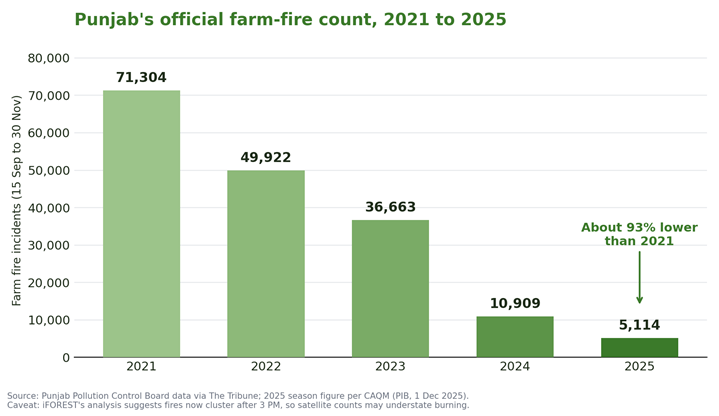
The long-term trend in fire counts is still striking:
If it’s illegal, why do farmers still burn parali?
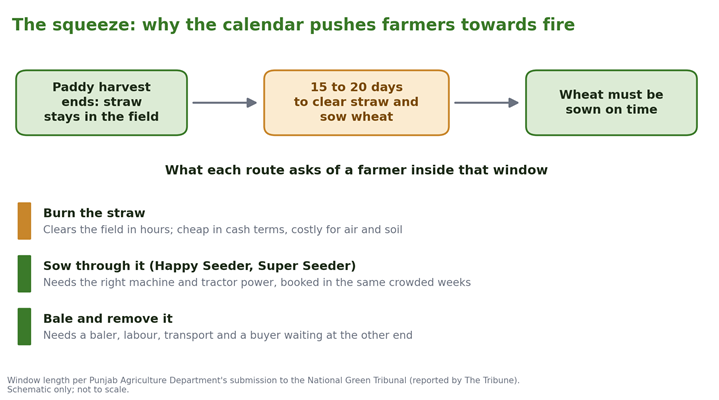
Because the ban fights the farm calendar. After the paddy harvest a farmer often has only a few weeks to clear the field and sow wheat. Burning clears it in hours. The alternatives cost money and need machines that are not always available when everyone wants them at once: baling the straw, hiring a Happy Seeder or Super Seeder, or waiting for a bio-decomposer to work.
A fine of ₹5,000 matters to a small farmer. So does losing days of sowing time or paying for straw removal when there is no buyer for the straw. That is why most experts argue that penalties work best alongside support: subsidised machinery, custom hiring centres, and a market that pays for the straw. We explain the economics in more depth in Stubble Burning in India: Why Parali Becomes Smoke. For the effect on city air, see how stubble burning contributes to Delhi’s winter smog.
Making residue worth more than a matchstick
The law can raise the cost of burning. A lasting fix also needs to raise the value of not burning. When crop residue has buyers, it gets collected. When it gets collected, supply chains form around it. Today those buyers include biomass power and pellet plants, compressed biogas units, mushroom growers, paper and packaging makers, and bio-composite manufacturers.
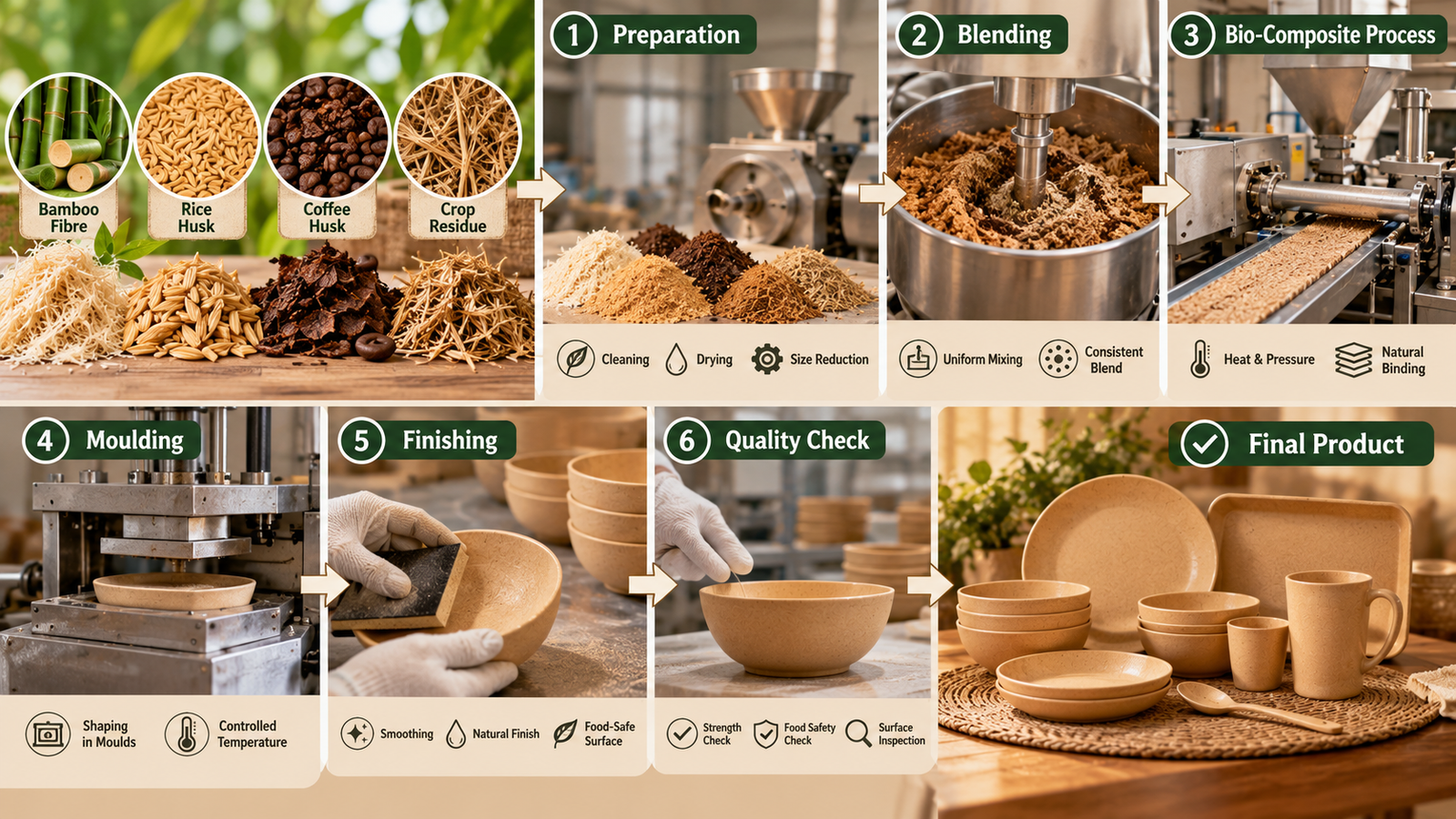
Pacing Grass is one small part of that shift. We make everyday tableware from bio-composites that use plant fibres and agricultural by-products, including bamboo fibre, rice husk and other crop-residue materials. No single company can absorb a season’s parali, and we don’t claim to. But every product that turns a farm by-product into something useful helps make the case that residue is a resource, not rubbish. If you’d like to see what that looks like on a table, our Bamboo Dinnerware Pair is a good place to start.

Browse our bamboo dinnerware range made with crop-residue bio-composites.
Frequently asked questions
Is stubble burning illegal in India?
Yes. Crop-residue burning is prohibited in Punjab, Haryana, Uttar Pradesh and Rajasthan under a 2015 NGT order and state directions under the Air Act, and it is restricted across Delhi-NCR under the CAQM Act, 2021. Farmers who burn stubble pay environmental compensation rather than facing criminal prosecution under the CAQM Act.
What is the fine for stubble burning?
Since November 2024 the environmental compensation is ₹5,000 per incident for holdings under 2 acres, ₹10,000 for 2–5 acres and ₹30,000 for more than 5 acres.
Can a farmer go to jail for burning parali?
Not under the CAQM Act, which keeps farmers outside its criminal penalties. Police cases have still been filed in some districts for disobeying local prohibitory orders, so the risk depends on how a state enforces the ban.
What does a red entry mean for a farmer?
It is a mark against the field or owner in land or crop records. In Haryana it can bar selling at government mandis for two seasons. A 2026 central draft proposes a 15-month red entry in revenue records, extendable for repeat burning or unpaid compensation.
Why is parali burnt even though it is banned?
Mainly because of the short gap between the paddy harvest and wheat sowing, the cost of removing straw, limited access to residue-management machines at peak time, and the lack of a reliable buyer for paddy straw.
One thought on “Is Stubble Burning Illegal in India? Fines, Red Entries and What the Law Says (2026)”