



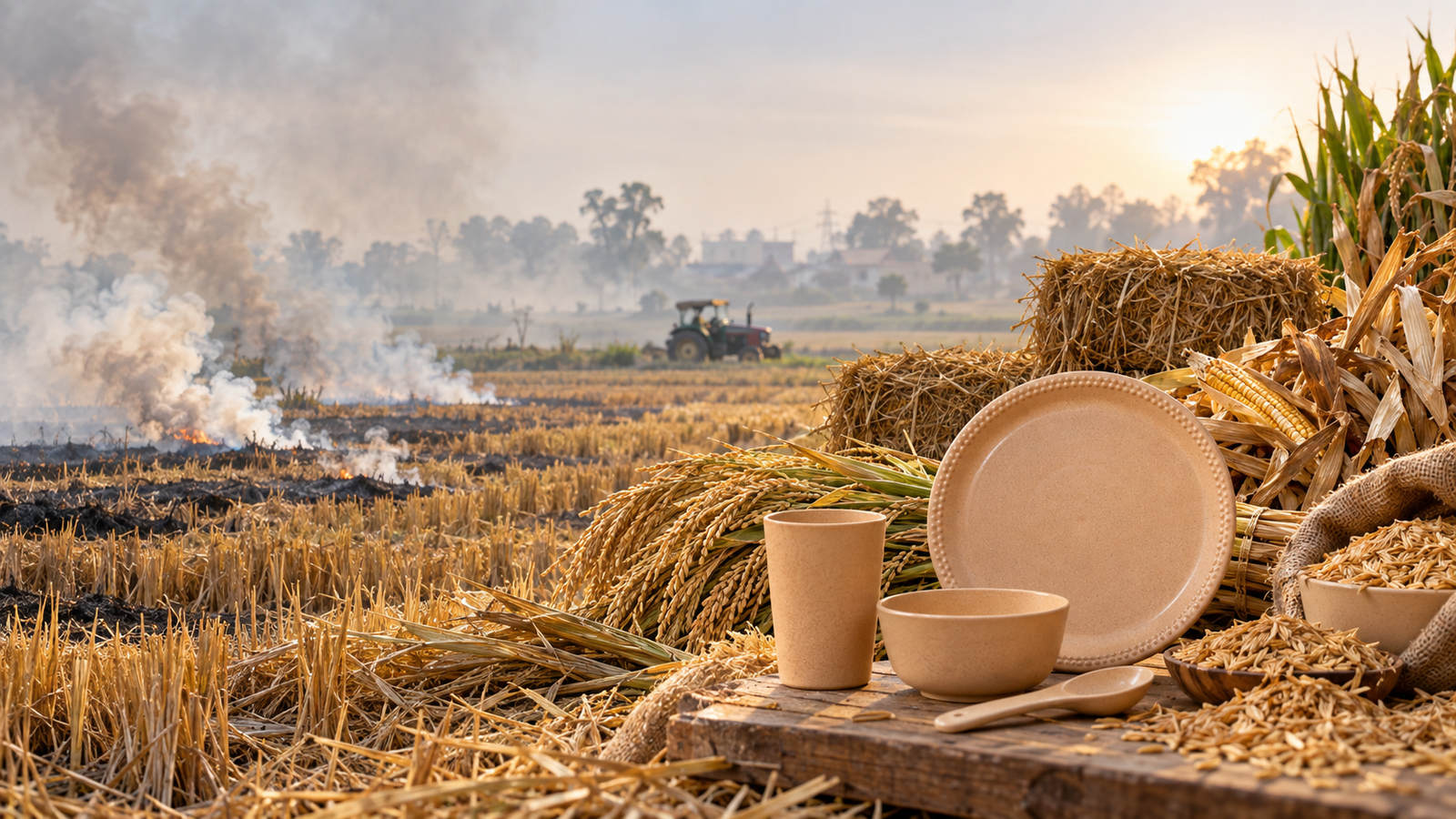
Parali is the stubble and straw left standing in the field after paddy (rice) is harvested. In English it is usually called paddy straw or rice stubble. Every October and November, farmers in Punjab, Haryana and western Uttar Pradesh need to clear this straw quickly so they can sow wheat, and many do it the fastest way: by setting it on fire. That practice, parali burning, is one of the reasons Delhi-NCR’s air turns grey each winter.
This guide explains what parali is, why it gets burned, what the rules say, and what the straw can become instead.
Parali meaning in English
“Parali” (पराली) is the Hindi and Punjabi word for the dry stalks of the rice plant that remain after the grain is cut. When a combine harvester cuts paddy, it takes the top of the plant with the grain and leaves 30 to 40 cm of stalk standing, plus loose straw on the ground. All of that together is parali.
- Parali = paddy straw, rice straw or rice stubble
- Parali burning = stubble burning or crop residue burning
- The husk that covers each rice grain is a different by-product, removed later at the mill. You can read about it in our guide to rice husk.
Why do farmers burn parali?
Farmers don’t burn parali because they want to pollute. They burn it because the calendar, the cost and the machines all push them that way.
1. The gap between harvests is very short
Paddy is harvested in October, and wheat has to be sown by mid-November for a good yield. That leaves roughly two to three weeks to clear the field. Fire clears an acre in a few hours.
2. Removing straw costs money
Machines like the Happy Seeder, super seeder or baler can manage the straw without burning, but they cost money to buy or hire, plus diesel and labour. For a small farmer, a matchstick is free.
3. Combine harvesters leave tall stubble
Harvesting by machine is faster than by hand, but it leaves standing stalks that are hard to plough back into the soil without extra equipment.
4. Paddy straw has few buyers
Wheat straw is fed to cattle, but paddy straw is high in silica, so it’s poor fodder. Without a nearby buyer, such as a biomass plant or a manufacturer, the straw has little value to the farmer.
How much parali is burned?
Punjab reported 5,114 farm fire cases in the 2025 paddy season. That’s far fewer than the peak years earlier in the decade, but enough to matter on bad-air days. Reports from the 2026 season put Punjab’s count close to that level again, with fines and FIRs filed against farmers who burned (OneIndia). Each fire seen by satellite can be a whole field, so the smoke adds up quickly when the wind blows towards Delhi.
Is parali burning illegal?
Yes. Burning crop residue is banned in Punjab, Haryana, Delhi and other states, and farmers can face environmental compensation, “red entries” in land records and FIRs. We explain the rules in detail in Is stubble burning illegal in India?
What else can parali become?
Paddy straw is a resource in the wrong place. Here’s where it can go instead of up in smoke:
- Back into the soil: mulching or ploughing it in with a Happy Seeder or super seeder adds organic matter.
- Bio-decomposer sprays: microbial sprays help the straw break down in the field.
- Energy: biomass power plants, compressed biogas and pellets for thermal plants.
- Packaging and boards: straw-based pulp and panels.
- Everyday products: companies like ours turn crop residue such as rice husk, together with bamboo fibre, into reusable plates, bowls and mugs.
Every one of these uses gives farmers a reason to collect the straw instead of burning it.
How Pacing Grass uses crop waste
Pacing Grass makes tableware from a bio-composite of bamboo fibre and crop residue. Our dinnerware, drinkware and serveware are made to be used every day for years, and each product gives crop waste a value beyond burning. Read our impact to see how we work with farm residue.
Frequently asked questions
What is parali called in English?
Parali is called paddy straw, rice straw or rice stubble in English. Burning it is called stubble burning or crop residue burning.
Which crop does parali come from?
Parali mainly comes from paddy (rice). The word is sometimes used for wheat stubble too, but the burning that affects Delhi’s winter air is mostly paddy straw.
Why is parali burnt in October and November?
Because paddy is harvested in October and wheat must be sown by mid-November. Burning is the fastest and cheapest way to clear the field in that short window.
Does parali burning cause Delhi’s pollution?
It is one major source on certain days, especially when winds carry smoke from Punjab and Haryana. Vehicles, construction dust, industry and weather also play big roles. We break this down in Delhi air pollution and stubble burning.