


Every October, as the paddy harvest begins to wind down across parts of Punjab, Haryana and western Uttar Pradesh, a familiar pattern starts appearing across northern India. Fields are cleared, smoke rises over agricultural land, and within weeks Delhi-NCR begins preparing for another difficult season of winter air pollution. News reports focus on satellite fire counts, AQI readings and the familiar phrase “stubble burning”, while the debate often settles into a simple question: why don’t farmers just stop burning parali?
The reality is considerably more complicated.
For many farmers, burning is not an ideal agricultural practice or a decision made in isolation. It is the result of a narrow window between paddy harvesting and wheat sowing, the cost of collecting and transporting straw, uneven access to machinery, the economics of the rice-wheat cropping system and the absence of a reliable market for all the residue being produced at the same time.
That makes stubble burning more than an air-pollution story. It is a story about agriculture, economics, technology, infrastructure and the value we assign to materials that are left behind after a crop is harvested.
And once we look at the problem that way, another question becomes possible: instead of asking only how to stop farmers from burning crop residue, can we create enough practical and economic uses for that residue that burning is no longer the easiest option?
What Is Stubble Burning?
After a combine harvester separates the rice grain from the plant, a considerable amount of straw and stalk material remains in the field. This agricultural residue is commonly referred to as paddy straw or parali in the North Indian context.
Stubble burning is the practice of setting this leftover material on fire so that the field can be cleared quickly before the next crop is planted.
The timing is crucial. Paddy harvesting generally takes place in October, while wheat sowing follows soon afterwards. When a farmer has only a few weeks to prepare the land, an operation that clears the field in hours can appear much more practical than one requiring several days of machinery, labour, baling, transportation and storage.
This is why the question “why do farmers burn parali?” cannot be answered simply by saying that burning is convenient. It is convenient because the agricultural system creates a very tight window and because alternative residue-management pathways are not equally accessible everywhere.
Why Do Farmers Burn Parali?
The harvest-to-sowing window is extremely tight
The rice-wheat cropping cycle is one of the most important pieces of the puzzle. Farmers need to harvest paddy and prepare their fields for wheat within a relatively short period. A delay in sowing can affect the following crop, making time an economic consideration rather than just a logistical one.
The rice-wheat system has deep economic roots
Punjab and Haryana became central to India’s food-grain production during and after the Green Revolution. Procurement systems and the established market for wheat and paddy helped make the rice-wheat rotation an important part of farm economics.
Changing that system is therefore not simply a matter of asking farmers to grow a different crop. Any alternative has to make economic sense for the farmer as well.
Paddy harvesting leaves substantial residue
Combine harvesters have transformed agricultural productivity by making harvesting faster and reducing dependence on manual labour. At the same time, mechanised harvesting can leave substantial straw and stubble distributed across the field.
Machinery such as straw-management systems, Happy Seeders and Super Seeders can address this problem, but access is not uniform across farms and regions.
Removing residue costs money
If straw is not burned, someone has to collect, bale, transport, store or process it. That means fuel, machinery, labour and logistics. For a farmer with a small holding, these additional costs can be difficult to absorb unless there is a reliable buyer or a service provider nearby.
This is one of the most important points in the entire stubble-burning debate:
An alternative is only a real alternative if it is affordable, available at the right time and practical at farm level.
Paddy straw does not have the same value as every other crop residue
Wheat straw, for example, has established uses as cattle fodder in many farming systems. Paddy straw can have more limited fodder applications depending on variety, quality and local livestock practices. That means the existence of a large quantity of straw does not automatically create a market for it.
The result is a difficult cycle: farmers need to clear the field quickly, while the material they remove has to travel through a supply chain that may not yet exist at sufficient scale.
How Does Stubble Burning Affect Delhi’s Air?
The connection between agricultural fires and Delhi’s winter air pollution is real, but it is often presented more simply than the science allows.
During October and November, weather patterns, wind direction and atmospheric stability can influence how pollution is transported and trapped over the Indo-Gangetic Plain. Smoke from agricultural fires can therefore contribute to the particulate pollution experienced in Delhi-NCR.
However, stubble burning is not the only source of Delhi’s winter pollution.
Vehicle emissions, industrial activity, construction and road dust, waste and biomass burning, secondary particulate formation and unfavourable meteorological conditions all contribute to the city’s air-quality problem. The estimated contribution of crop-residue burning can also vary significantly from one day to another.
This distinction matters because two statements can both be true: crop-residue burning can make Delhi’s air worse during the post-harvest period, while eliminating it alone would not solve Delhi’s year-round air-pollution problem.
The more useful approach is therefore to treat stubble burning as one seasonal component of a much larger regional air-quality challenge.
The Health Cost Is Not Limited to Delhi
The people living closest to agricultural fires are not only city residents.
Open biomass burning releases fine particulate matter and other pollutants. PM2.5 can penetrate deep into the respiratory system, and exposure to polluted air is associated with a range of respiratory and cardiovascular health risks.
Farmers, agricultural workers and rural communities can experience direct exposure because the source of the smoke is often close to homes and workplaces.
This is why framing the issue as “farmers versus Delhi” is misleading. The people working in and around the fields are also living with the consequences of seasonal smoke.
The environmental problem and the public-health problem are connected on both sides of the agricultural-urban divide.
What Does Stubble Burning Do to Soil?
The smoke is the most visible consequence, but burning also changes what happens to the soil.
Crop residues contain nutrients and organic material that could otherwise contribute to the soil system. When residue is burned, some nutrients are lost rather than being returned through decomposition. Repeated burning can also affect soil organic matter and soil biological activity.
This creates an irony: the fastest way of clearing the field can remove material that could otherwise contribute to long-term soil health.
The question is therefore not simply how quickly residue can disappear, but how its nutrients and organic matter can be used most effectively.
What Has India Tried So Far?
India has developed a broad set of responses to crop-residue burning rather than relying on one intervention.
These include subsidies for residue-management machinery, custom hiring centres, in-situ management technologies, bio-decomposer approaches, biomass utilisation, crop diversification and regulatory measures.
The machinery route is particularly important because it addresses the problem at the point where it begins.
Happy Seeder and Super Seeder
These machines allow wheat to be planted while managing existing paddy residue, reducing the need to completely clear the field before sowing.
Straw-management systems
Attachments such as Super Straw Management Systems can chop and distribute residue more evenly, making subsequent field operations easier.
Bio-decomposers
Microbial formulations such as the Pusa bio-decomposer have been promoted as a way to accelerate decomposition of crop residue in the field.
Custom hiring centres
Instead of requiring every farmer to purchase expensive machinery, custom hiring systems allow farmers to access equipment when they need it.
Biomass energy
Baled agricultural residue can potentially enter biomass-energy supply chains, including pellet and briquette production and co-firing applications.
These interventions matter because they demonstrate that crop residue does not have to be treated as a single type of waste.
Different residues can have different destinations.
The Alternatives to Stubble Burning Are Bigger Than One Machine
There is no single replacement for open-field burning.
Instead, the alternatives can broadly be divided into in-situ management, where residue is managed within the field, and ex-situ utilisation, where it is collected and used somewhere else.
In-situ approaches include direct seeding, residue incorporation, mulching and biological decomposition. These can return organic material to the soil and reduce the need to transport bulky biomass.
Ex-situ approaches create an entirely different possibility. Straw can be baled and transported to biomass facilities, processed into fuel, used as a substrate for mushroom cultivation, or explored as a raw material for paper, packaging and composite materials.
The best option depends on the crop, geography, farm size, local infrastructure and economics.
From Crop Residue to Raw Material
This is where the conversation around stubble burning connects with a much broader idea: agricultural residue as an industrial resource.
Once a material leaves the field, it does not necessarily have to become waste. Depending on its properties, it can become an input for another process.
Paddy straw can have agricultural and industrial applications. Rice husk has a different material profile and can be used in different applications. Other crops generate their own distinctive residues, from wheat straw and maize stalks to sugarcane bagasse and cotton stalks.
This diversity is important because crop residue is not one material.
The materials differ in fibre structure, moisture, density, composition, availability and processing requirements. Consequently, the most appropriate use for one residue may be completely different from the best use for another.
That is where material science becomes relevant.
What Is a Bio-Composite?
A bio-composite is a composite material that incorporates biological or plant-derived components, such as natural fibres or agricultural residues, into a material system designed for a specific application.
The concept is particularly interesting for agricultural residue because it changes the question from “How do we dispose of this material?” to “Can this material become part of something useful?”
But bio-composites should not be presented as a magic solution.
A crop residue cannot simply be picked up from a field and turned into a finished product. It may require drying, cleaning, grinding, fibre preparation, formulation and controlled processing. Different residues also behave differently during manufacturing.
The real opportunity lies in identifying which agricultural materials are technically suitable, economically collectable and commercially useful.
Where Does Pacing Grass Fit Into This Story?
This is where Pacing Grass connects naturally with the larger crop-residue conversation.
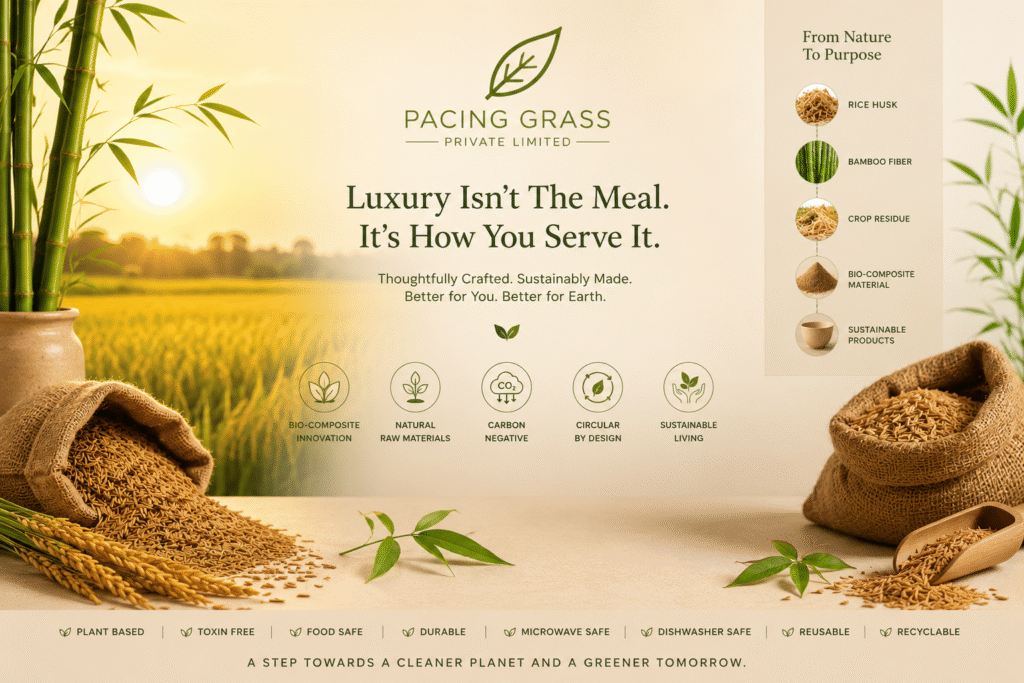
Pacing Grass develops bio-composite products using plant-based fibres and agricultural residues, including bamboo fibre, rice husk, coffee husk and crop-residue-based materials.
The important point is that the material story is not limited to one crop or one form of agricultural waste.
Paddy straw may be one part of India’s residue challenge, but it is only one part of the country’s much larger agricultural biomass landscape. Rice husk is another material. Coffee husk is another. Bamboo provides another plant-fibre resource. Different residues can have different technical roles depending on their characteristics and processing requirements.
That is why a multi-material approach is important.
The objective is not to claim that every piece of stubble can become a Pacing Grass product. It cannot, and responsible material development should never make that claim.
The larger idea is to create more possible destinations for suitable agricultural and plant-based materials.
Instead of seeing the lifecycle as:
Crop → harvest → residue → burning
a circular material pathway can look more like:
Crop → harvest → residue → collection → processing → bio-composite material → useful product
The difference is not merely environmental. It is economic.
A material with a viable market has a reason to be collected.
And a reason to be collected can create the foundation for a supply chain.
Why Pacing Grass Doesn’t Focus on Just One Crop Waste
One of the most important distinctions is between solving one waste stream and developing a material platform.
A company focused exclusively on paddy straw would depend heavily on one crop, one geographic concentration and one seasonal availability pattern. A broader bio-composite approach can explore different suitable plant fibres and agricultural by-products according to their material properties and supply.
That does not mean every residue can replace every other residue. It means the material-development process can investigate different resources rather than assuming that one agricultural waste stream must provide the answer to everything.
This matters because India’s agricultural economy is extremely diverse.
The residue generated after rice harvesting is not the same as the residue generated after wheat, maize, sugarcane or cotton cultivation. Their physical properties, collection systems and existing markets differ.
A genuinely scalable agricultural-residue economy therefore needs multiple materials, multiple applications and multiple supply chains.
Pacing Grass’s bio-composite approach fits into that larger direction by exploring how plant fibres and agricultural by-products can become inputs for everyday products rather than remaining unused or underutilised.
Can Bio-Composites Solve Stubble Burning?
Not on their own.
This is worth stating clearly because it makes the broader argument more credible.
No tableware company, biomass plant or single technology can absorb all of the crop residue produced across northern India. The solution requires farmers, machinery providers, aggregators, transporters, processors, manufacturers, policymakers and consumers to participate in a functioning ecosystem.
For bio-composite manufacturing to contribute meaningfully, several things need to work together:
- residue must be collectable at a reasonable cost;
- farmers and aggregators need reliable logistics;
- the material needs appropriate preprocessing;
- manufacturers need consistent feedstock;
- products need genuine market demand;
- and environmental claims need to be supported by appropriate testing and end-of-life pathways.
This is why the most realistic vision is not one solution replacing burning, but a network of different solutions in which each residue stream goes where it creates the most appropriate combination of agricultural, environmental and economic value.
The Difference Between “Waste” and “Resource”
There is a subtle but important change in perspective here.
When agricultural residue has no buyer, no convenient use and no practical collection system, it behaves economically like waste.
When there is a market for it, the same material becomes a resource.
That does not mean every residue suddenly becomes valuable. Collection costs, transport, processing and market demand still determine whether a material can realistically enter a circular supply chain.
But it does demonstrate why creating demand for agricultural residues can be part of the long-term solution.
A farmer should ideally have more than two choices: burn the residue or spend money getting rid of it.
There should be viable pathways that allow suitable residue to remain in the field, return to the soil, enter agricultural uses, generate energy or become an industrial raw material.
Bio-composites are one of those potential pathways.
Stubble Is Only the Beginning
The word parali has become almost synonymous with India’s stubble-burning problem, but it represents only one part of a much broader resource landscape.
India’s farms produce a wide range of biological materials after harvesting. Some should return to the soil. Some can support livestock or other agricultural activities. Some can become energy. Some can be processed into paper, packaging, boards or composite materials.
The important question is not whether every agricultural residue can be turned into a product.
It is whether we can build a system where the most suitable use is easier, more accessible and more economically attractive than simply burning the material.
That requires better farm machinery, stronger collection networks, local processing infrastructure, reliable markets and continued investment in material science.
It also requires changing the way we talk about agricultural residue.
Instead of seeing it only as something left behind after harvest, we can begin to see it as a distributed stream of plant-based resources.
From Smoke to Resource
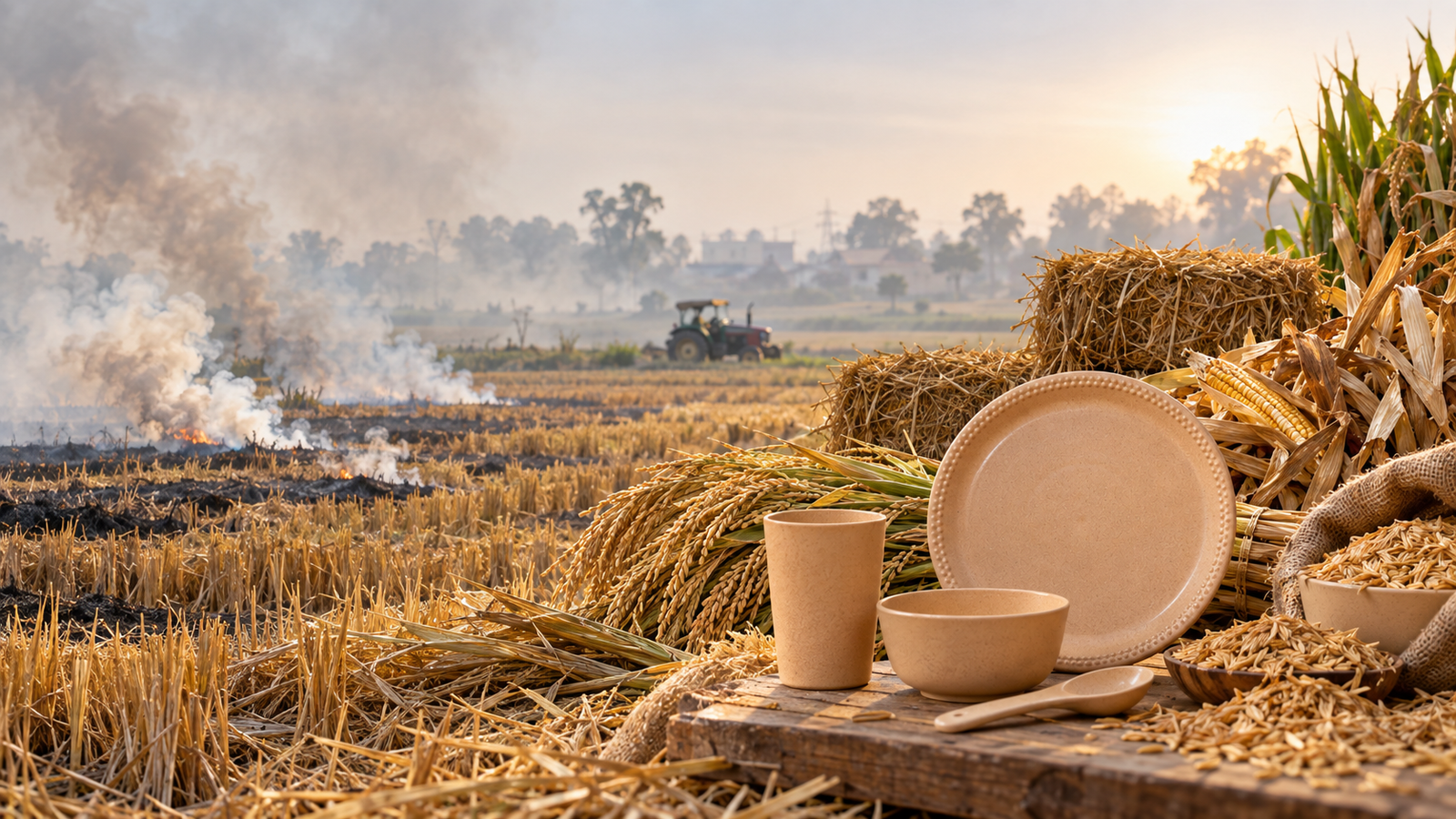
Every winter, the images are familiar: burning fields, hazy skies and another debate over who is responsible for Delhi’s pollution.
But the agricultural-residue story does not have to end with smoke.
The same broad category of materials can have very different second lives depending on where they are generated and what infrastructure exists around them. One residue may become compost, another may generate energy, another may support mushroom cultivation, while another may become an input for paper, packaging or a bio-composite.
Pacing Grass represents one example of that broader material transition, exploring how plant fibers and agricultural by-products can be incorporated into bio-composite products for everyday use.
It is not the complete answer to stubble burning.
It is an example of a larger idea: when agricultural residue has a useful destination, it stops being only a disposal problem and starts becoming part of a resource economy.
Perhaps that is the question worth asking this winter.
Not simply:
“Why are farmers still burning parali?”
But:
“How can we make the residue valuable enough that burning it no longer makes economic sense?”
Because the long-term solution to stubble burning may not begin with finding another way to destroy agricultural residue.
It may begin with finding more useful things to do with it.
Frequently Asked Questions
Why do farmers burn stubble in India?
Farmers often burn paddy residue because they have a short period between paddy harvesting and wheat sowing. Collecting, baling and transporting the residue can require additional machinery, labour and money, while burning clears the field quickly.
Is stubble burning the main cause of Delhi’s air pollution?
No. Crop-residue burning is a seasonal contributor, particularly during the post-paddy-harvest period, but Delhi’s air pollution also comes from vehicles, industry, dust, waste and biomass burning, secondary particulate formation and unfavourable weather conditions.
What are the alternatives to stubble burning?
Alternatives include Happy Seeder and Super Seeder technology, residue incorporation, mulching, bio-decomposer applications, baling for biomass, biomass pellets and briquettes, Bio-CNG, mushroom cultivation, paper and packaging applications, and suitable bio-composite materials.
What is crop residue?
Crop residue refers broadly to plant material left behind after harvesting or agricultural processing. Depending on the crop, it can include straw, stalks, leaves, husks, cobs, shells and other plant-based by-products.
Is parali the same as all crop residue?
No. In the North Indian context, parali commonly refers to paddy straw, while crop residue is a broader category covering materials generated from many different crops and agricultural processes.
What can agricultural waste be used for?
Depending on its characteristics, agricultural residue can be returned to soil, composted, used in mushroom cultivation, converted into biomass energy, or processed into materials such as paper, packaging, boards and bio-composites.
What is a bio-composite?
A bio-composite is a composite material that incorporates biological or plant-derived materials such as natural fibres or agricultural residues into a material system designed for a particular application.
How does Pacing Grass use agricultural residue?
Pacing Grass develops bio-composite products using plant-based fibres and agricultural-residue inputs, including materials such as bamboo fibre, rice husk, coffee husk and crop-residue-based materials. Its approach represents one potential downstream use of suitable agricultural and plant-based resources.