



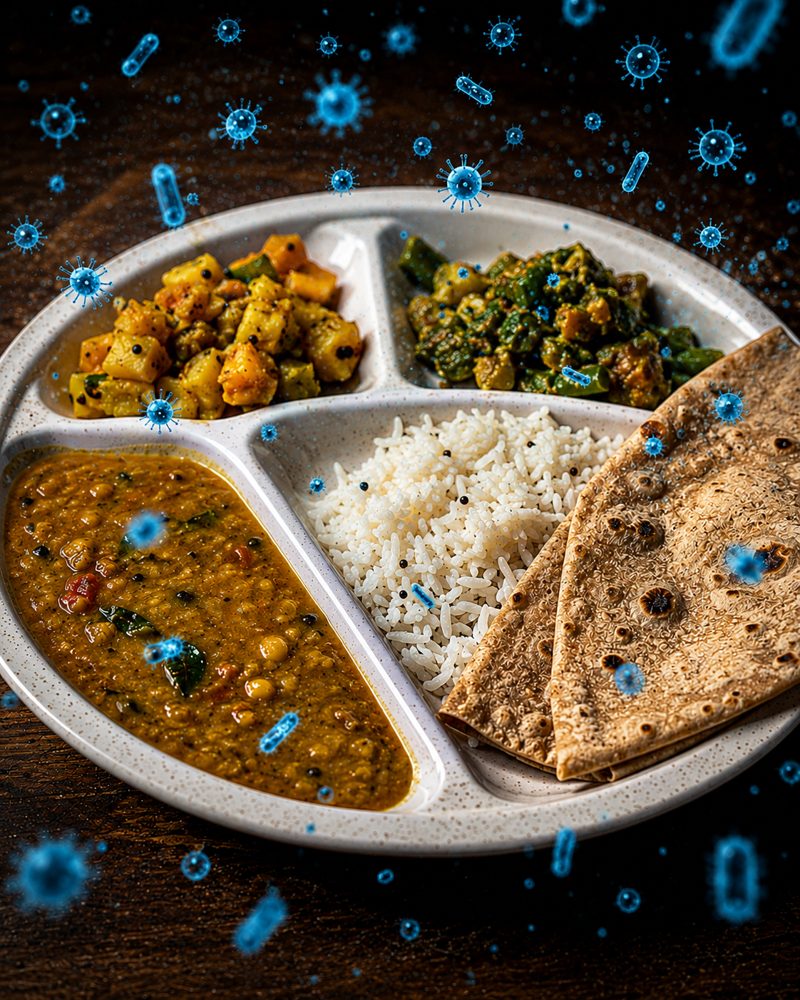
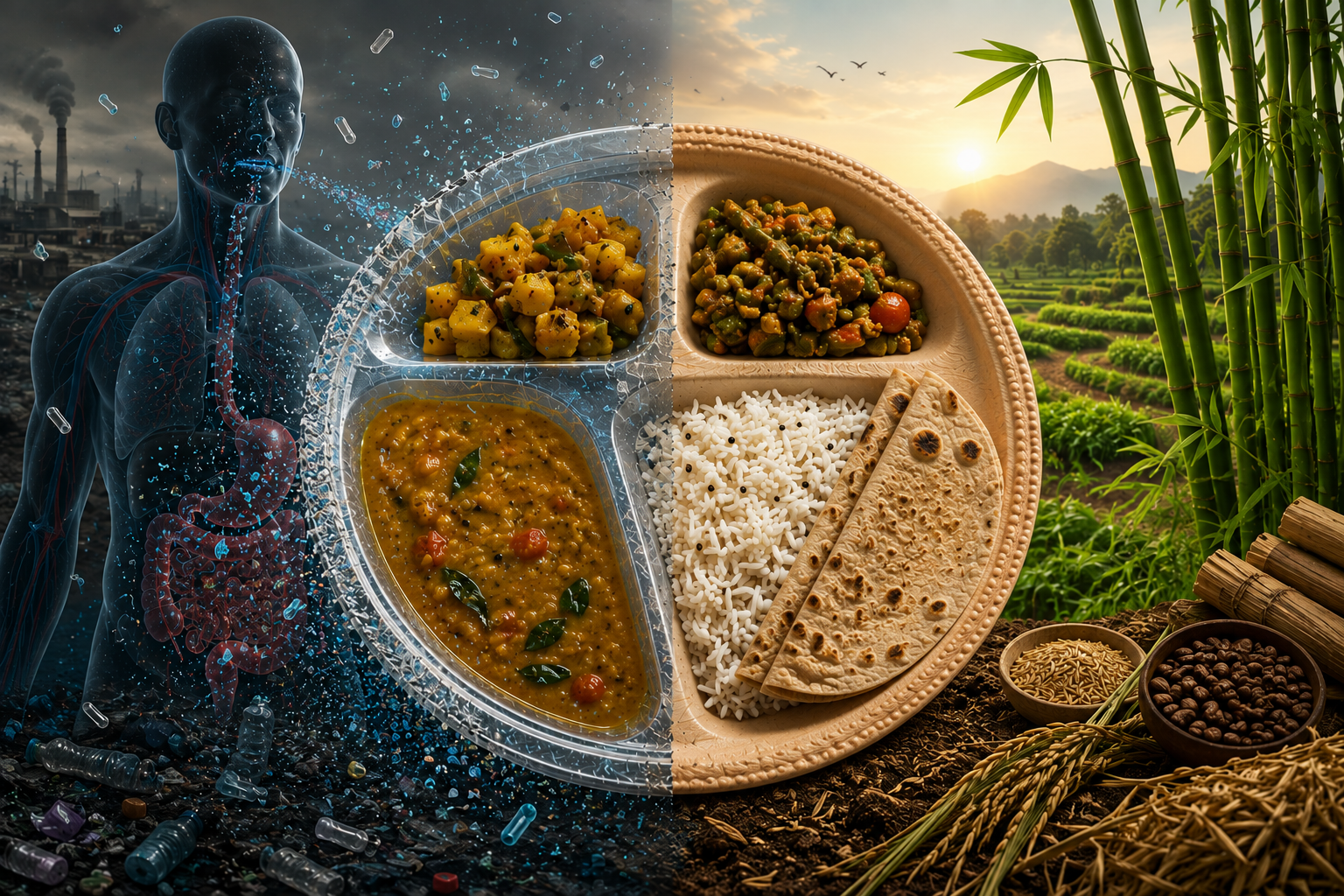
They are invisible to the naked eye. They survive boiling, freezing, and digestion. They have been found in human blood, brain tissue, and the food you ate for breakfast. Microplastics are now an unavoidable part of modern dining — but the materials revolution may already have an answer.
📖 12 min read 🔬 Peer-reviewed sources 🌱 Sustainable solutions explored in the Indian context
| 77% of adults with microplastics in their blood | 240K plastic fragments in 1L of bottled water | 10–12M metric tons of plastic waste generated by India annually | 2× higher heart attack risk with microplastics in artery tissue |
There is a small experiment you can do the next time you heat a meal in a plastic container. You don’t need a lab. You don’t need equipment. You just need to know that according to peer-reviewed research, repeated heating of PET and polypropylene containers causes consistent leaching of plastic particles into whatever food is inside. You have probably done this hundreds of times without a second thought.
Most of us have. Across India and around the world, plastic has become the default material for plates, bowls, takeaway containers, restaurant ware, and kitchen storage—not because it is the safest option, but because it is cheap, lightweight, and familiar. For decades, that was enough. The science is now suggesting it may not be.
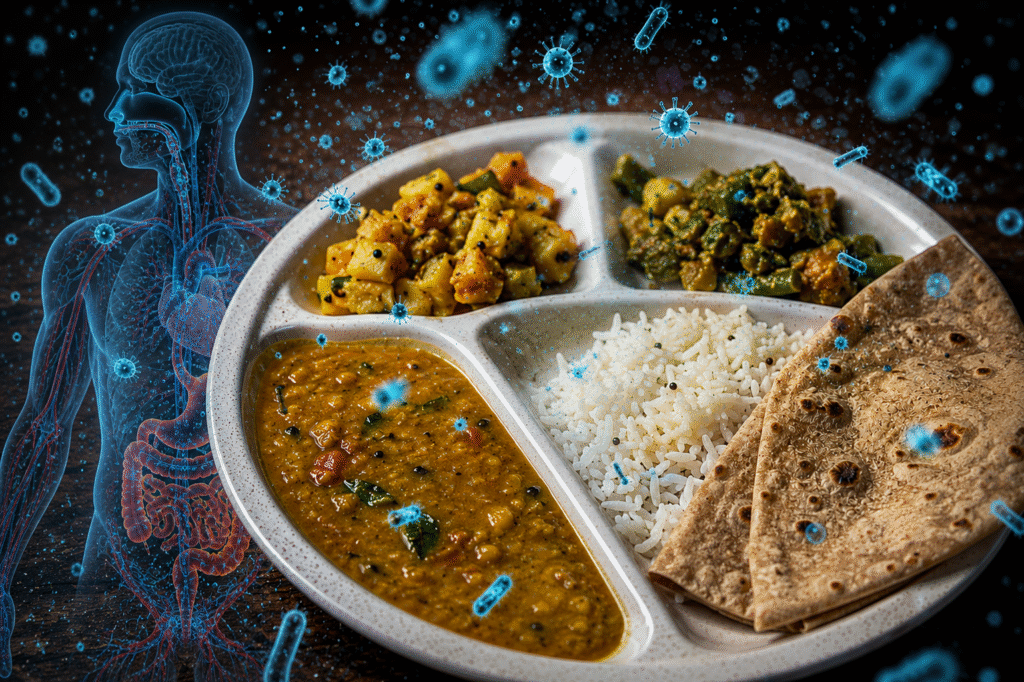
“The microplastics story has moved from an environmental concern about oceans and marine life to a human health question that nobody has fully answered, because the research is racing to catch up with a contamination that is already comprehensive.” — One Green Planet, June 2026, summarising current scientific consensus
What Are Microplastics, Exactly?
The term “microplastic” describes any plastic particle smaller than 5 millimeters. Below 1 micrometer, they become nanoplastics—particles so tiny they can cross cell membranes and enter the bloodstream directly from the gut. They come from two sources: primary microplastics are manufactured small (think microbeads in cosmetics and fibers shed by synthetic clothing); secondary microplastics form when larger plastic objects break apart under UV radiation, heat, and mechanical stress—including the friction of a fork against a scratched plastic plate.
They end up everywhere. Researchers have found microplastics at the peak of Everest, in the Mariana Trench, in Arctic ice cores, in baby poop, in the placentas of unborn children, and — as of a landmark 2022 study — in human blood itself.

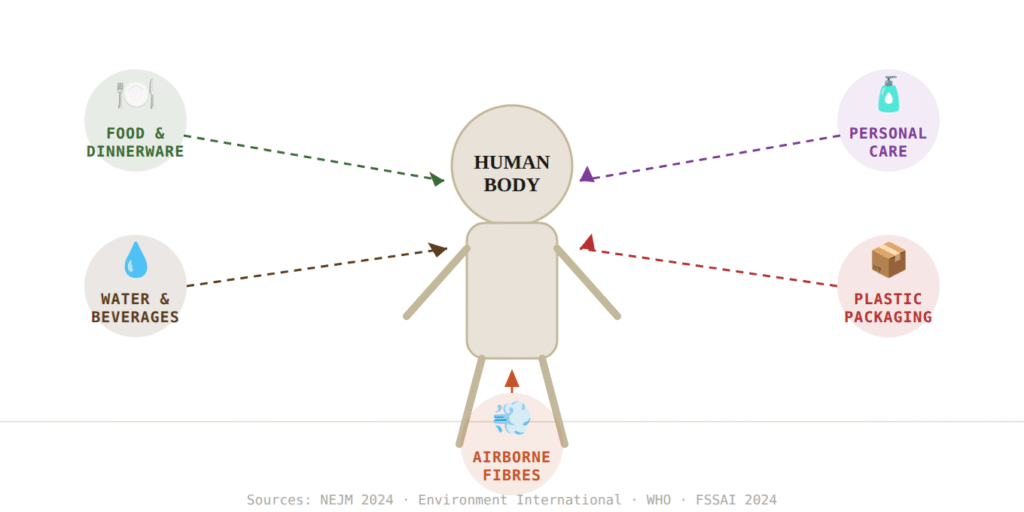
WHERE MICROPLASTICS ENTER THE HUMAN BODY · KEY PATHWAYS
A Brief History of Plastic in Our Kitchens
The story of plastic in our kitchens is a story of convenience winning over caution—until the evidence became impossible to ignore.
1950s – 1960s
Mass-produced plastic enters the home kitchen. Bakelite, then polystyrene and polyethylene, make plates, cups, and containers affordable for the first time. The postwar boom frames plastic as progress.
1970s – 1980s
Melamine dinnerware explodes in popularity across Asia and India, prized for being lighter and cheaper than ceramic. Cheap, colorful, and seemingly unbreakable—it becomes standard in restaurants, dhabas, and homes alike.
1990s – 2000s
BPA (Bisphenol A) concerns emerge as research links the chemical, found in polycarbonate plastics, to hormonal disruption. Baby bottle manufacturers face global backlash. The term “BPA-free” becomes a marketing tool — though many BPA replacements carry similar risks.
2013
A landmark study in JAMA Internal Medicine confirms that melamine dinnerware can leach large amounts of melamine into hot food. The very plates served in millions of Indian restaurants and canteens are a source of chemical exposure.
2022
Scientists detect microplastics in human blood for the first time — in 77% of healthy adult participants. The study, published in Environment International, marks a turning point: plastic contamination is no longer just an environmental story.
2024
The New England Journal of Medicine publishes the first clinical outcome study linking microplastics to hard health events: patients with microplastics in their carotid artery tissue had twice the risk of heart attack or stroke. FSSAI launches India’s first study assessing microplastic exposure levels in Indian food. Toxics Link finds microplastics in every single salt and sugar brand tested in India.
2025 – PRESENT
Microplastics are detected in human brain tissue at concentrations that rose measurably over just eight years. India’s National Green Tribunal urges regulatory action. The race for food-safe, plastic-free alternatives accelerates.
India’s Particular Vulnerability
In the global microplastics crisis, India sits at an especially fraught intersection. The country generates between 10 and 12 million metric tons of plastic waste annually, much of which is unrecovered or mismanaged. Single-use plastic — the kind that fragments into microplastics fastest — is everywhere: in street food packaging, in chai glasses, in takeaway containers, in restaurant plate ware.
⚠️ INDIA-SPECIFIC FINDING · 2024
Research by environmental advocacy organization Toxics Link, noted by India’s National Green Tribunal, found microplastics present in every salt and sugar brand tested in India—both packaged and unpackaged, premium and budget, including those marketed as organic. The NGT urged authorities to establish permissible limits and regulatory standards.
The problem is compounded by how Indian food is typically served. Hot curry, dal, rice — all foods that are acidic, hot, or oily — are the conditions under which plastic leaches most aggressively. Studies show that exposure to high temperatures significantly increases the migration of chemicals from plastic plates and containers into food. The humble melamine thali of the neighbourhood dhaba may be delivering something extra with every meal.
The Melamine Problem Nobody Talks About
Walk into almost any canteen, mess hall, roadside eatery, or mid-range restaurant across India and you will find melamine dinnerware. It looks vaguely like ceramic. It feels sturdy. It is cheap, light, and doesn’t break when dropped. It is also, when used with hot food, a chemical delivery mechanism.
“Melamine tableware may release large amounts of melamine when used to serve high-temperature foods.
Research cited by NutritionFacts.org, summarising peer-reviewed studies on melamine migration
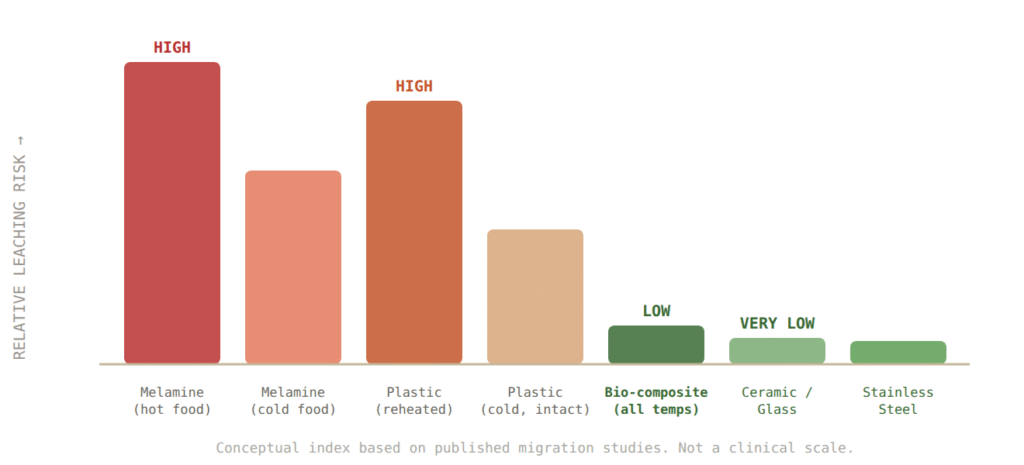
In a study reviewed in JAMA Internal Medicine, participants who ate hot noodle soup from melamine bowls showed detectable levels of melamine in their urine within hours — a level significantly higher than the control group using ceramic. The FDA confirms the concern: at temperatures above 70°C or with highly acidic foods, melamine migration accelerates. Hot dal, hot tea, hot sabzi — all are served above this threshold, routinely.
And this is before we even consider plastic cutting boards, plastic spoons, and the plastic-wrapped ingredients that food is prepared with in the first place. Research in Beyond the Food on Your Plate (PMC, 2024) found that the home kitchen itself — through storage, heating, and preparation — is a significant contributor to microplastic exposure, not just the raw ingredients.
LEACHING RISK BY MATERIAL TYPE & CONDITION (CONCEPTUAL INDEX)
What Exactly Is the Health Risk?
The honest answer is more than we knew last year and less than the worst headlines imply. Here is where the science genuinely stands.
What is established: Microplastics enter the human body and circulate in the bloodstream. A 2024 study in Environment International confirmed microplastics in 77% of healthy adult blood samples. A 2024 study in Scientific Reports found them in 88.9% of participants, with polystyrene and polypropylene most prevalent — both common in kitchenware. More recently, microplastics have been detected in human brain tissue, with concentrations measurably rising over just eight years. In laboratory settings, microplastics trigger inflammation, oxidative stress, and cellular disruption.
What crosses from correlation to clinical concern: A March 2024 study published in the New England Journal of Medicine found that patients with microplastics detected in their carotid artery plaques had significantly higher rates of heart attack, stroke, or death over the following three years — the first major study linking microplastics to hard clinical outcomes in real humans.
What is still being researched: The direct causal mechanisms between everyday exposure levels and specific human diseases are not yet fully mapped. This is not reassurance — it is a research gap. The contamination is already comprehensive. The science is racing to catch up.
| ⚕️ REGULATORY NOTE — INDIA 2024 India’s FSSAI launched the project “Micro- and Nano-Plastics as Emerging Food Contaminants” in March 2024, in collaboration with CSIR-IITR Lucknow, ICAR, and BITS Pilani — the first national effort to generate India-specific data on microplastic exposure in food. No binding regulations are yet in place. The European Union has already begun banning intentional microplastic additions under REACH regulation (EU 2023/2055). |
The Case for a Material Rethink
The typical response to health scares about materials is to look for a like-for-like replacement. Ban plastic straws; get paper straws. Stop using melamine plates; buy ceramic ones. And ceramic, glass, and stainless steel are genuinely safer options — their leaching risk is extremely low.
But there is a second dimension to this problem that a simple material swap doesn’t address: what happens to the material when it’s done being used? Ceramic breaks and goes to landfill. Stainless steel requires significant energy to produce. Glass is heavy, fragile, and energy-intensive to manufacture. These materials solve the health problem at the table but don’t solve the planet problem in the supply chain.
This is where agro-waste bio-composites enter the story — and where India has a particularly interesting opportunity.
| BAMBOO FIBER The fastest-growing plant on Earth. No fertilizer, no pesticide. Naturally antimicrobial. Sequesters carbon as it grows. | RICE HUSK 320 million tonnes generated globally per year. High in silica. Traditionally burned—a waste of resources and a source of pollution. | COFFEE HUSK The outer shell of the coffee bean is typically discarded. Rich in cellulose. Can form strong, food-safe composite material. | PARALI Crop stubble from rice and wheat harvesting. Traditionally burned in Punjab and Haryana, causing severe air pollution across northern India. |
Each of these materials is currently classified as agricultural waste. In northern India, parali burning — the practice of burning crop residue after harvest — contributes significantly to the toxic smog that blankets Delhi, Lucknow, and other cities every winter. Rice husk silica is simply discarded. Coffee husk goes to landfill. Bamboo, if not harvested, is left to decompose.
| 💡 THE WASTE-TO-WORTH EQUATION India generates enormous quantities of agricultural waste that is currently treated as a liability — burned (causing air pollution), dumped (causing soil and water contamination), or simply left to rot. Converting this waste stream into durable, food-safe bio-composite materials doesn’t just create a plastic alternative. It addresses the waste problem at source, supports farming communities, and builds a genuinely circular economy. |
Bio-Composites: Promise, Caveats, and What to Look For
It is important to be precise here, because “bamboo dinnerware” and “bio-composite dinnerware” are not the same thing—and not all products in either category are equal.
A significant portion of what is sold as “bamboo tableware” globally—particularly cheap products from mass manufacturers—is actually a bamboo-fiber-plus-melamine plastic composite. These products have faced regulatory action across the EU for exceeding melamine migration limits and making misleading claims. They are not the answer to the melamine problem; they contain melamine. This is a real risk, and consumers deserve to know it.
Genuine bio-composites made from agricultural fiber with food-safe, non-plastic binding agents are a different category entirely. Research into natural fiber composites—bamboo, sugarcane bagasse, and rice husk—shows high tensile strength, superior oil resistance, excellent hydrophobicity, low heavy-metal content, and degradability within 60 days under natural conditions. Critically, these materials do not rely on melamine, BPA, or synthetic polymer resins for their structure.
MATERIAL PROPERTIES COMPARISON: PLASTIC VS BIO-COMPOSITE VS CONVENTIONAL ALTERNATIVES
| Property | Melamine Plastic | Standard Plastic | Agro-Waste Bio-Composite | Ceramic / Glass |
| BPA-Free | ✓ Yes (but contains melamine) | ~ Varies | ✓ Yes | ✓ Yes |
| Chemical Leaching (Hot Food) | ✗ Significant | ✗ Significant | ✓ None (food-safe composite) | ✓ Negligible |
| Microwave Safe | ✗ No | ~ Some types | ✓ Yes (Pacing Grass) | ✓ Yes (ceramic) |
| Dishwasher Safe | ~ Top rack only | ~ Often not | ✓ Yes | ✓ Yes |
| Biodegradable | ✗ No (hundreds of years) | ✗ No | ✓ Yes | ✗ No (inert) |
| Carbon Footprint | ✗ High (petrochemical) | ✗ High | ✓ Carbon-locking (negative) | ~ Moderate |
| Agro-Waste Utilised | ✗ No | ✗ No | ✓ Yes (core ingredient) | ✗ No |
| Shatter-Resistant | ✓ Yes | ✓ Yes | ✓ Yes | ✗ Fragile |
| UV Resistant | ~ Limited | ~ Degrades | ✓ Yes | ✓ Yes |
| Weight (for hospitality) | Light | Light | Light | Heavy |
India Is Already Building the Answer
The shift away from petroleum-based materials toward agro-waste composites is not a Western idea that needs to be imported. India has the raw material base, the agricultural communities, and the innovation infrastructure to lead this transition from within.
Several IIT-incubated startups are already converting what was once burned or dumped into functional, durable, food-safe products. The approach isn’t limited to tableware — the same materials and processing techniques are being applied to corporate gifting, hospitality solutions, and engineering applications. The technology is patentable, scalable, and demonstrably superior to its plastic predecessors on multiple metrics simultaneously: health safety, environmental impact, and durability.
| THE PARALI CONNECTION Parali burning—the annual burning of crop residue by farmers in Punjab and Haryana — contributes significantly to the catastrophic air quality events that affect northern India every October and November. The practice is not stubborn farming tradition; it is economic necessity. Farmers burn because they have no fast, affordable way to dispose of residue before the next planting window. Converting parali into a raw material for bio-composite manufacturing creates a direct economic incentive to stop burning — and turns a pollution source into a product. |
This is the logic of circular innovation: rather than treating agricultural waste as a problem to be managed, it becomes a feedstock to be valued. Rice husk, which is generated in enormous quantities wherever rice is grown (India produces over 120 million tonnes of rice annually), has properties — particularly its high silica content — that make it a natural structural filler for composite materials. Coffee husk, generated along the coffee supply chain, similarly finds a second life.
What Should You Actually Change in Your Kitchen?
The goal of this article isn’t to create anxiety but to enable informed choices. Here are the practical implications of the current evidence:
1. Stop reheating food in plastic containers
This is the single highest-impact change most households can make. Research consistently shows that the combination of heat, acidic food, and plastic is where the most aggressive leaching occurs. Reheat in ceramic, glass, or stainless steel. If you must use plastic, never heat above 60°C and replace any scratched or warped plastic immediately.
2. Be sceptical of “melamine-free” claims on bamboo tableware
Many bamboo fibre products on the market contain melamine resin as a binder. Look for products that specify their composite chemistry clearly, are food-grade tested, and carry verified certifications. The category of genuine agro-waste bio-composites is distinct from bamboo-melamine blends.
3. Choose materials that earn their keep twice
A material that is safe at the table and responsible in production is a better choice than one that solves only half the problem. Ceramic is safe but heavy and energy-intensive. Bio-composite products made from agro-waste can be food-safe, durable, lightweight, and produced from materials that would otherwise pollute the environment.
4. Ask about your restaurant’s ware
The next time you sit down in a canteen, hotel, or restaurant, notice what your food is being served on. Melamine plate, plastic bowl, ceramic cup — these are choices that the establishment makes, and they are increasingly the kind of choices that sustainability-conscious diners, corporate clients, and regulatory bodies are asking about.
A Different Kind of Plate
Microplastics are not a problem created overnight, and they will not be solved overnight. But the direction of science is clear: the materials we eat from matter, in ways that are only beginning to be fully quantified. The habit of treating plastic as a neutral, harmless default — especially for hot food — is one that the evidence is asking us to revise.
The encouraging part of this story is that the alternatives are no longer hypothetical or expensive or exotic. India, with its vast agricultural base and its tradition of innovation under constraint, is in a position to manufacture materials that are safer at the table, better for the planet, and more honest about where they come from.
Every plate made from something that would otherwise have been burned in a field is, in a small but real sense, two problems solved at once. That is not a marketing line. It is a genuinely different way of thinking about what a plate is for.
FILED UNDER: #microplastics #sustainableliving #ecofriendly #bamboo #bioplasticIndia #plasticfree #agrowasteIndia #sustainableIndia #greenkitchen
| PACING GRASS PRIVATE LIMITED · IIT KANPUR SIIC INCUBATED: Purpose in Every Particle We make tableware, kitchenware, and corporate gifting products from bamboo, rice husk, coffee husk, and parali—India’s agricultural waste streams—using patented bio-composite technology. Our products are food-grade, BPA-free, dishwasher-safe, microwave-safe, carbon-locking, and manufactured in India. Explore Our Products → Shop – Pacing Grass & Gifting Enquiries → B2B & Gifting Archives – Pacing Grass |
Are bamboo composite products actually safe for hot food?
Genuine bio-composite products made from agricultural fibers with food-safe binders (not melamine-based) are considered safe for serving hot food. They are food-grade tested, BPA-free, non-toxic, and do not rely on synthetic resins that are known to migrate. The key distinction is between bamboo-melamine composites (which can leach melamine at high temperatures) and genuine agro-waste bio-composites that use different binding technologies. Always look for clear food-safety certification and material disclosure.
Are microplastics in India’s food supply proven?
Yes. A 2024 study by Toxics Link found microplastics in every salt and sugar sample tested in India — across all brands, both packaged and unpackaged. India’s FSSAI has acknowledged the concern and launched a national study (2024) to quantify microplastic exposure levels across different food types. The National Green Tribunal has also formally urged action on this issue.
How do agro-waste bio-composites actually get made?
The process typically involves cleaning and processing agricultural fibre (bamboo, rice husk, parali, coffee husk), converting it into pellets or granules via compounding, and then moulding it into shapes using heat and pressure. The key innovation lies in the bio-composite formulation — the combination of fibres and food-safe binding agents that determines the mechanical properties, food safety, and environmental profile of the final product. Patented composite technologies can optimise for strength, flexibility, moisture resistance, and thermal stability simultaneously.
Is this really carbon-negative? How?
Plants sequester carbon from the atmosphere as they grow. When agricultural residue like rice husk, bamboo fibre, or parali is incorporated into a durable product rather than burned or decomposed, that carbon remains locked in the material rather than being released back into the atmosphere. Combined with the displacement of petroleum-based plastics (whose production is carbon-intensive), the net effect across the product lifecycle can be carbon-negative — i.e., more carbon is locked in than is emitted in production.
Can these products be customised for corporate or hospitality use?
Yes. Bio-composite materials can be moulded into a wide range of forms and sizes — from standard dinnerware to bespoke gifting items, trays, organisers, and drinkware — and can incorporate branding through colour, engraving, or packaging. For hospitality (hotels, restaurants, catering) and corporate gifting contexts, these products offer the dual value of practical functionality and a demonstrable ESG and sustainability story.