



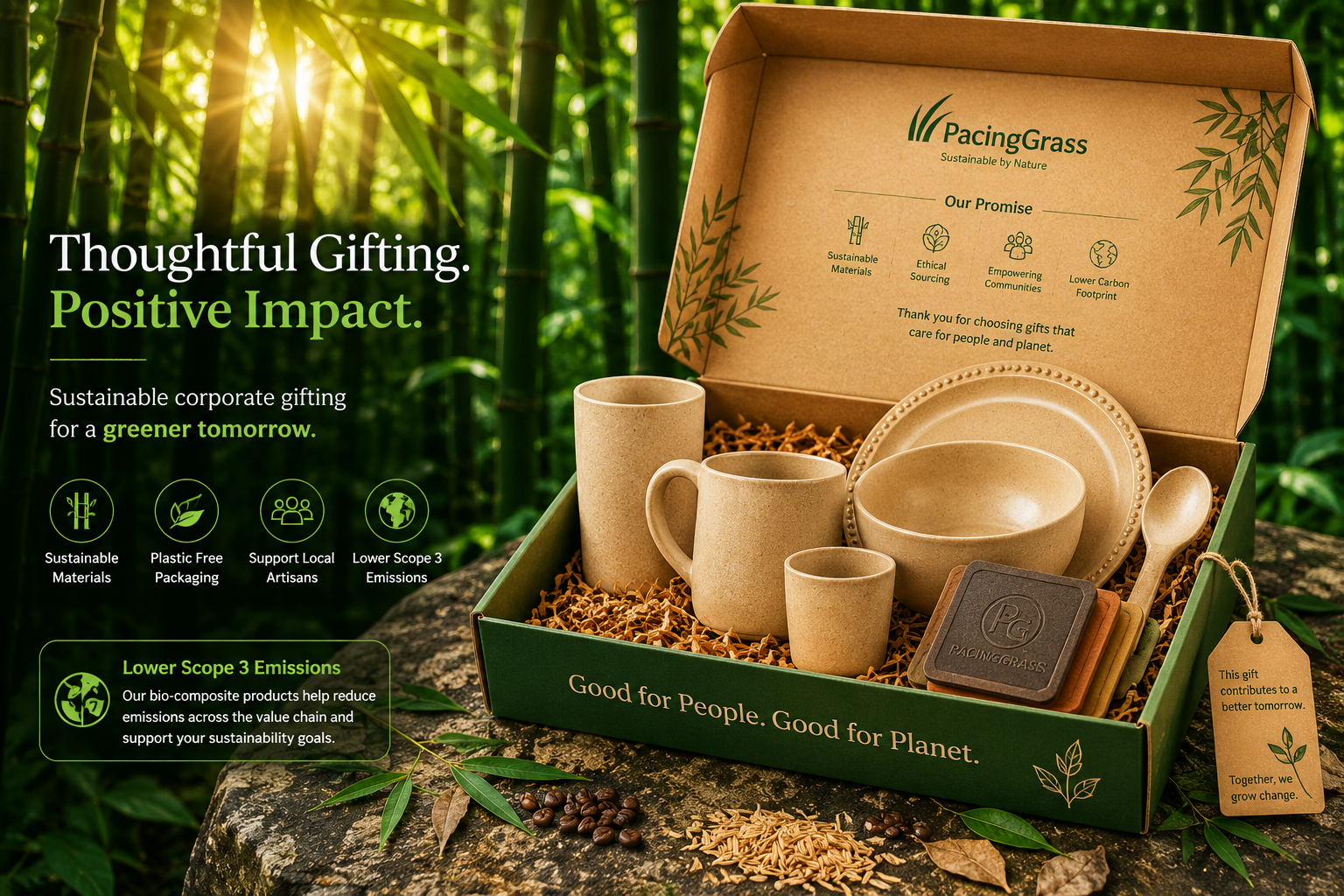
Does Your Corporate Gifting Count?
Every Diwali, every quarter-close, every client milestone — Indian corporates spend thousands of crores on gifts. Chocolates, dry fruits, branded mugs, plastic hampers, fast-fashion lifestyle kits. But here’s the question that is rapidly moving from boardroom buzzword to regulatory obligation: does your corporate gifting appear in your Scope 3 emissions report?
If you answered ‘I’m not sure,’ you are not alone — and this article is for you.
India’s top 1,000 listed companies now operate under SEBI’s Business Responsibility and Sustainability Reporting (BRSR) framework. Scope 3 emissions — those sitting outside your direct control — are moving from a ‘leadership indicator’ to an essential one. Your gifting vendor is part of that story. The material your gift is made from, the factory it came from, and what happens when it is thrown away — every stage generates carbon, and under the GHG Protocol, much of it falls squarely on your emissions inventory.
| 📌 Quick Answer Yes. Corporate gifts — from branded mugs to festive hampers — are captured under Scope 3 Category 1 (Purchased Goods and Services) of the GHG Protocol. When you buy eco-friendly, carbon-negative materials like bamboo or rice husk, you materially reduce that footprint AND strengthen your BRSR disclosure. |
1. What Are Scope 3 Emissions? The Plain-English Version
The Greenhouse Gas (GHG) Protocol — the global standard for carbon accounting — divides a company’s emissions into three scopes:
- Scope 1: Direct emissions from sources your company owns or controls — fuel in company vehicles, gas in your kitchen, factory boilers.
- Scope 2: Indirect emissions from the electricity, heat, or steam you purchase.
- Scope 3: Every other indirect emission across your entire value chain — upstream from your suppliers, downstream through customers, and everything in between.
Here is the number that stops most sustainability managers in their tracks:
| 📊 Key Stat Scope 3 emissions account for an average of 75–90% of a company’s total carbon footprint (GHG Protocol / MIT Sustainable Supply Chain Lab, 2024–2025). Yet only about 15% of large public companies fully disclose Scope 3 data — making it the most under-reported and highest-impact area in corporate sustainability. |
The GHG Protocol subdivides Scope 3 into 15 categories. Corporate gifting — the physical goods you purchase and give away — sits firmly in Category 1: Purchased Goods and Services, which is the largest Scope 3 category for most companies. For manufacturing-heavy organisations, Category 1 can represent up to 84% of total Scope 3 footprint.
2. How Corporate Gifting Creates a Scope 3 Footprint
When your procurement team orders 500 branded ceramic mugs or 1,000 plastic hamper kits, a chain of emissions is triggered—long before those gifts arrive in the hands of your clients:
| Metric | Finding |
| Raw Material Extraction | Mining clay, drilling for plastic feedstock, logging timber — all high-carbon |
| Manufacturing & Firing | Kilns for ceramics, injection moulding for plastic — energy-intensive |
| Packaging Production | Cardboard, bubble wrap, ribbons — often virgin materials |
| Inbound Transportation | Freight from manufacturer to your warehouse |
| Distribution Logistics | Last-mile delivery to hundreds of offices across India |
| End-of-Life Disposal | Plastic mugs → landfill/incineration; ceramics → non-recyclable waste |
Under the GHG Protocol Scope 3 Standard, all upstream emissions from cradle-to-gate of the goods you purchase are attributable to you. This means the emissions from producing, transporting, and packaging your Diwali gift hamper are your emissions — not just your supplier’s.
For a mid-sized Indian company spending ₹50 lakhs on annual corporate gifting in conventional plastic/ceramic/printed goods, this can represent several hundred tonnes of CO₂e per year—a figure that will increasingly appear under regulatory scrutiny.
3. BRSR India: Why Your Gift Vendor Now Matters to SEBI
India’s Business Responsibility and Sustainability Reporting (BRSR) framework — mandated by SEBI for the top 1,000 NSE-listed companies by market capitalisation — already requires Scope 1 and Scope 2 disclosure. Scope 3 is currently a leadership indicator, but signals from SEBI and global regulatory convergence (EU CSRD, SEC climate rules) point clearly toward mandatory Scope 3 disclosure in the near future.
According to CFA Institute research on BRSR adoption, less than 40% of Indian companies reported Scope 3 data in FY23 — an important gap as global buyers, especially from the EU and US, now routinely request full value-chain emissions from Indian exporters and suppliers.
Under BRSR Principle 6 (Protect and Restore the Environment), companies are encouraged to disclose all 15 GHG Protocol Scope 3 categories. Best-practice guidance recommends reporting at minimum: Categories 1, 3, 4, 6, and 7 — with Category 1 (Purchased Goods and Services) being the most material for most organisations.
| ⚡ BRSR Action Point for Procurement Teams If you are preparing BRSR disclosures, your gifting vendor’s material choices directly impact your Category 1 emissions. Switching to a BRSR-aligned vendor using certified sustainable materials is one of the fastest, most visible ways to reduce your Scope 3 footprint — with the paper trail to prove it. |
4. The Carbon Maths: Conventional Gifts vs. Sustainable Alternatives
Let’s make this real. Compare a standard corporate gifting order of 500 units across material types:
| Gift Item | Material | Approx. CO₂e / unit | 500 units total |
| Ceramic Mug | Fired Clay | ~1.2 kg CO₂e | ~600 kg CO₂e |
| Plastic Travel Mug | Polypropylene | ~2.1 kg CO₂e | ~1,050 kg CO₂e |
| Bamboo Mug | Moso Bamboo | ~0.3 kg CO₂e* | ~150 kg CO₂e* |
| Rice Husk Bowl | Agricultural Waste | ~0.2 kg CO₂e* | ~100 kg CO₂e* |
| Bio-composite Tray | Natural Fibre Blend | ~0.25 kg CO₂e* | ~125 kg CO₂e* |
*Indicative estimates based on published LCA data for bamboo vs. conventional materials. Bamboo sequesters carbon during growth, making it one of the few materials that can be carbon negative on a lifecycle basis when sourced responsibly and produced locally.
The saving is not just in production — bamboo and natural fibre products do not end up in landfill in the same way: they are biodegradable, compostable, and in many cases reusable across multiple years. That means lower end-of-life Scope 3 emissions too.
5. What Makes a Gift ‘Carbon Negative’? Understanding the Lifecycle
The phrase ‘carbon negative gift’ is not marketing language — it has a specific technical meaning rooted in lifecycle assessment (LCA). A product is carbon negative when the carbon it sequesters during growth exceeds the emissions from its entire production, transport, and end-of-life chain.
Bamboo is one of the world’s fastest-growing plants, sequestering up to 12 tonnes of CO₂ per hectare per year — significantly more than most timber species. When you manufacture tableware, gifting sets, or serving trays from sustainably harvested bamboo, you are essentially locking sequestered carbon into a useful product.
For your Scope 3 calculations, this matters because:
- Your Category 1 emission factor for bamboo-based purchased goods is dramatically lower than for plastic or ceramic equivalents
- You can document a verifiable emissions reduction—not just an offset—within your own supply chain
- A supplier who can provide product carbon footprint (PCF) data per unit elevates your BRSR and ESG reporting quality from estimates to primary data
6. India-Specific Context: The HORECA & Corporate Gifting Intersection
India’s HORECA sector (Hotels, Restaurants, Catering) and its corporate gifting market are deeply intertwined. The same bamboo bowl set a company gifts to a client could be on a five-star hotel’s breakfast table. The same filter coffee set bamboo that finds its way into a sustainability-themed Diwali hamper is equally at home in an eco-conscious café in Ghaziabad or Bengaluru.
This overlap creates a unique opportunity for Indian businesses sourcing from manufacturers like PacingGrass: one sustainable vendor relationship can serve multiple ESG imperatives simultaneously — corporate gifting, in-office tableware, client entertainment ware, and event catering — all contributing positively to your Scope 3 Category 1 footprint.
Particularly noteworthy for procurement teams: India is one of the few countries with domestic production capacity for bamboo tableware, bio-composite serving trays, and rice husk tableware at bulk wholesale scale. Sourcing locally also reduces Scope 3 Category 4 (Upstream Transportation) emissions — a double win for BRSR reporters.
7. Choosing a BRSR-Aligned Gifting Vendor: 7 Questions to Ask
. Choosing a BRSR-Aligned Gifting Vendor: 7 Questions to Ask
- Can you provide product-specific carbon footprint data (kg CO₂e per unit)? — This enables precise Scope 3 Category 1 calculations rather than industry estimates.
- Are your materials certified or traceable? — FSC, ISO 14001, or equivalent certifications for bamboo, natural fibre, or bio-composite materials.
- Are your products biodegradable, compostable, or recyclable? — End-of-life matters for Scope 3 Category 12 (End-of-Life Treatment of Sold Products).
- Do you use renewable energy in manufacturing? — A supplier powered by solar or green energy directly lowers your Category 1 footprint.
- Is the manufacturing facility domestic (India)? — Local sourcing significantly cuts Category 4 (Upstream Transportation) emissions.
- Can you support customisation for our BRSR/ESG reporting? — BRSR-aligned vendors should be able to provide supplier-level ESG questionnaire responses.
- Do your products carry a ‘plastic-free’ or ‘single-use-plastic-free’ declaration? — Aligned with India’s plastic ban regulations and EPR frameworks.
8. How PacingGrass Products Map to Your Scope 3 Categories
At PacingGrass, every product is designed with one goal: to help Indian businesses reduce their environmental footprint without compromising on aesthetics, durability, or bulk pricing. Here’s how our product categories directly address your Scope 3 reporting:
| PacingGrass Product | GHG Protocol Category | Why It Counts |
| Bamboo Tableware (Bulk Buy India) | Category 1 — Purchased Goods | Replaces high-carbon ceramic/plastic; lowest CO₂e per unit in tableware segment |
| Eco Friendly Crockery Set India | Category 1 — Purchased Goods | Full dining sets with documented lower lifecycle emissions vs. conventional crockery |
| Bamboo Coffee Mug Wholesale India | Category 1 — Purchased Goods | Ideal corporate gift; replaces single-use & plastic mugs; biodegradable |
| Bio Composite Serving Tray India | Category 1 — Purchased Goods | Natural fibre blend; carbon-sequestering materials; HORECA-grade durability |
| Eco Tableware for Restaurants Bulk | Category 1 — Purchased Goods | Restaurant & hotel supply; bulk pricing for HORECA Scope 3 reduction |
| Plastic Free Dinner Set India | Category 1 — Purchased Goods | Fully certified plastic-free; supports EPR compliance and BRSR Principle 2 |
| Rice Husk Tableware Supplier India | Category 1 — Purchased Goods | Agricultural waste upcycling; near-zero virgin resource extraction |
| Eco Diwali Gift Set Corporate India | Category 1 — Purchased Goods | Festive gifting with measurable lower Scope 3 vs. conventional hampers |
| Filter Coffee Set Bamboo India | Category 1 — Purchased Goods | South India café culture meets sustainability; gifting and HORECA use |
| Bamboo Bowl Set India | Category 1 — Purchased Goods | Versatile gifting/tableware; FSC-trackable bamboo sourcing |
| Horeca Bamboo Spoon Set India | Category 1 — Purchased Goods | Replaces single-use cutlery; bulk wholesale for HORECA sector |
| Customized Bamboo Tableware India | Category 1 — Purchased Goods | Brand-engraved eco gifts; each unit documented for BRSR supplier data |
| Eco Friendly Kullad India | Category 1 — Purchased Goods | Traditional Indian form, sustainable material; carbon-negative profile |
| Table Organizer Bamboo Fiber India | Category 1 — Purchased Goods | Office gifting; replaces plastic desk accessories |
| Sustainable Hotel Tableware Supplier | Category 1 — Purchased Goods | Hotel procurement; full ESG documentation available for supply chain audits |
| Corporate Sustainable Serving Tray | Category 1 — Purchased Goods | Board/meeting room gifting; premium natural fibre; no plastic components |
| Carbon Negative Gift India | Category 1 (Net Negative) | Verified sequestration > production emissions on lifecycle basis |
| Eco Friendly Bottle India | Category 1 — Purchased Goods | Reusable bamboo/natural bottle; replaces plastic water bottles in gifting |
| Natural Fiber Plates Wholesale Ghaziabad | Category 1 — Purchased Goods | Manufactured locally in NCR; low Category 4 transport emissions; bulk pricing |
9. The Green Gifting Playbook: A Step-by-Step for Procurement Teams
Step 1 — Audit Your Current Gifting Spend
List all categories of goods purchased as corporate gifts in the last 12 months. Include festive hampers, branded merchandise, hospitality items, and office gifts. Note the primary material (plastic, ceramic, metal, textile, bamboo, etc.).
Step 2 — Apply Spend-Based Emission Factors
For each category, apply industry-average emission factors from the GHG Protocol spend-based method. SEBI BRSR guidance accepts spend-based estimates as a starting point for Category 1 reporting. A ₹1 lakh gifting spend in conventional ceramic/plastic goods typically equates to 1.5–3 tCO₂e depending on materials and sourcing geography.
Step 3 — Switch to Activity-Based Tracking with Eco Vendors
Once you transition to vendors who can provide product-level carbon data, your Scope 3 reporting upgrades from spend-based estimates to activity-based primary data — a major quality improvement that auditors, investors, and global buyers reward.
Step 4 — Document, Disclose, and Communicate
Include your gifting emissions reduction as a named initiative in your BRSR Principle 2 (Sustainable Goods and Services) and Principle 6 (Environment) disclosures. Quantify the CO₂e saved year-on-year. This narrative — that you actively chose carbon negative gift India options — is powerful for ESG investor communication, brand reputation, and client relationships.
10. Real-World Impact: What Switching to Eco Gifting Actually Achieves
To illustrate the real-world impact, consider a company transitioning its annual gifting programme from plastic promotional merchandise to bamboo tableware bulk buy India and eco friendly crockery set India from suppliers like PacingGrass:
| Metric | Finding |
| SME (100 gifts/yr) — Plastic to Bamboo | ~85 kg CO₂e saved (~3.5x lower footprint) |
| Mid-size Corp (500 gifts/yr) — Ceramic to Bamboo | ~450 kg CO₂e saved (~4x lower footprint) |
| Enterprise (5,000 gifts/yr) — Mixed to Eco Suite | ~4.5 tCO₂e saved (reportable BRSR reduction) |
| Hotel (HORECA 10,000 covers/day eco switch) | ~12+ tCO₂e/yr saved vs. disposable plastic |
| Carbon-negative product lifecycle (bamboo) | Net negative: sequesters more CO₂ than produced |
These numbers are not just environmental — they are financial and reputational. ESG-rated companies attract better credit terms, stronger investor interest, and are increasingly preferred by procurement teams of global multinationals who require supply chain sustainability data from Indian vendors.
Conclusion: Your Gifts, Your Scope 3, Your Choice
Corporate gifting is not a footnote in your sustainability strategy — it is a line item in your Scope 3 emissions inventory. Every gift you send is a choice: to add to the carbon burden your company reports, or to subtract from it.
India now has the domestic manufacturing infrastructure, the regulatory framework (BRSR), and the market pressure (global buyers, ESG investors) to make sustainable corporate gifting the default — not the exception. Green gifting solutions for companies India is no longer a niche market; it is the direction the entire procurement industry is heading.
At PacingGrass, we have built our entire product range around this transition: from bamboo tableware bulk buy India to plastic free dinner set India price, from eco friendly kullad India to buy rice husk tableware supplier India and bio composite serving tray India — every SKU is designed to be BRSR-aligned, traceable, and genuinely lower in carbon footprint.